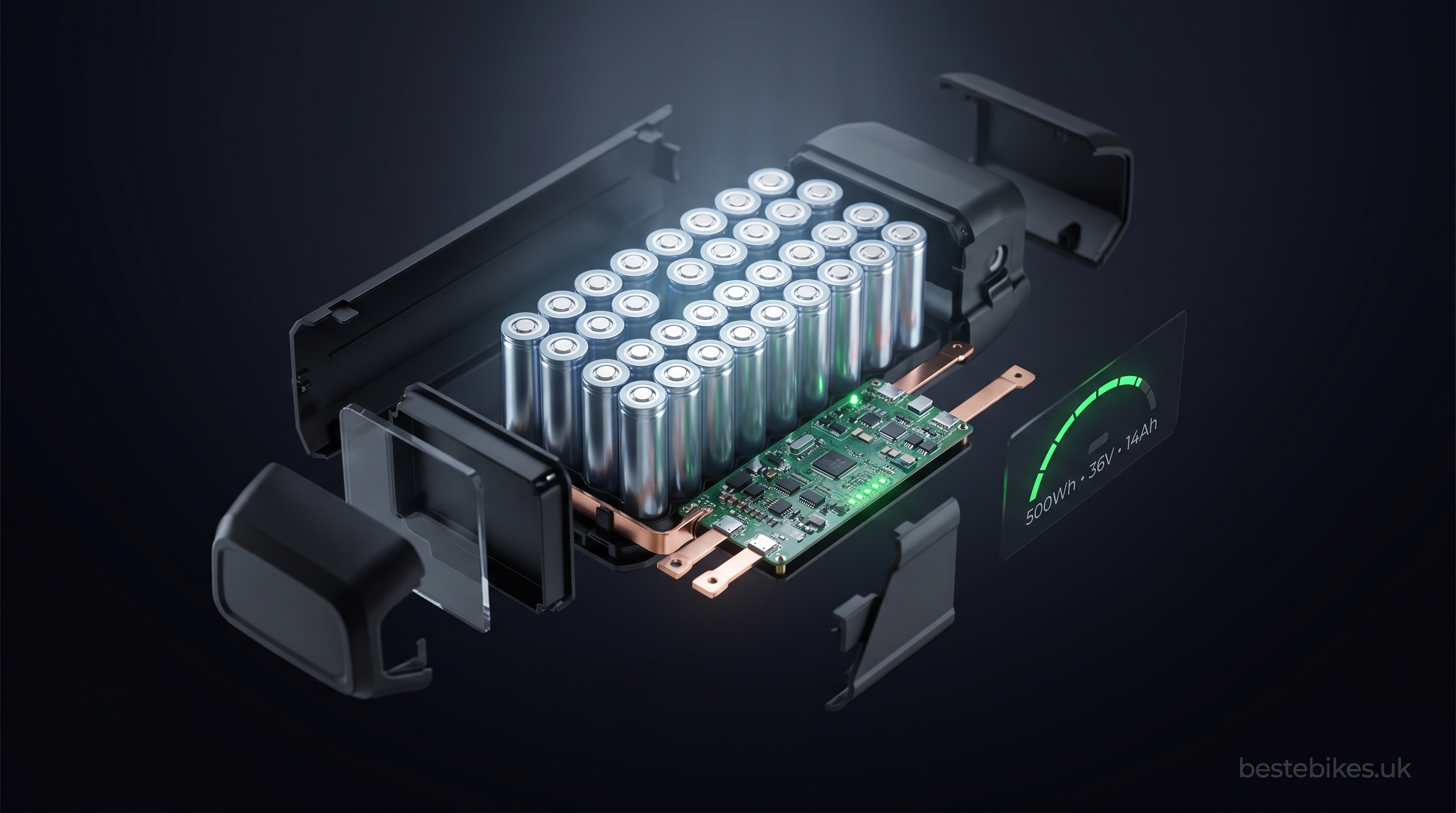
E-Bike Battery Guide: Everything You Need to Know in 2026
If there's one component that truly defines your e-bike experience, it's the battery. I've spent the last few years testing dozens of electric bikes across the UK, and I can tell you with confidence: the battery is where the magic happens — and where most buyers get confused. So let me break it all down for you.
What Does "Wh" Actually Mean?
You'll see every e-bike spec sheet quoting a number in Wh (watt-hours). Think of it as the fuel tank size of your e-bike. A higher Wh rating means more stored energy, which generally translates to more range. Simple enough — but the real-world picture is a bit more nuanced.
The formula is straightforward: Voltage (V) × Amp-hours (Ah) = Watt-hours (Wh). So a 48V 15Ah battery gives you 720Wh. Most UK e-bikes sit somewhere between 300Wh and 960Wh, with the sweet spot for commuters being around 500–720Wh.
Battery Sizes Across Popular UK E-Bikes
Here's a comparison of batteries across some of the bikes we've reviewed — it's quite a spread:
| Bike | Battery (Wh) | Motor Type | Charge Time | Weight (kg) | Price |
|---|---|---|---|---|---|
| Engwe LE20 | 922 Wh | Mid-Drive | 7h | 36.8 | £1,199 |
| Himiway Escape Pro | 840 Wh | Hub | 7h | 42.0 | £1,599 |
| Himiway D5 2.0 | 720 Wh (960 opt.) | Hub | 6h | 41.7 | £1,999 |
| Engwe L20 3.0 Pro | 720 Wh | Mid-Drive | 2h | 32.8 | £1,399 |
| Engwe L20 3.0 Boost | 648 Wh | Hub | 1.75h | 33.2 | £1,049 |
| Fiido C11 Pro | 499 Wh | Hub | 5h | 25.0 | £950 |
| Engwe N1 Air | 360 Wh | Hub | 6h | 15.6 | £1,199 |
| Fiido E-Gravel | 209 Wh | Hub | 3h | 17.5 | £1,090 |
Notice something interesting? The L20 3.0 Boost and L20 3.0 Pro charge in under 2 hours — that's genuinely game-changing for commuters who can top up at work. Meanwhile, some 720Wh+ batteries take 6–7 hours to fully charge. Fast charging tech is becoming a real differentiator.
How Much Range Will You Actually Get?
This is the million-pound question, isn't it? Manufacturers love quoting optimistic range figures, and I get it — they're testing on flat ground, with a lightweight rider, in perfect conditions. Real UK riding? Hills, headwinds, and a rucksack full of shopping.
As a rough rule of thumb, expect 60–75% of the claimed range in typical mixed UK riding. Here's what affects it:
- Rider weight — every extra 10kg costs you roughly 5–8% range
- Hills — a hilly commute can halve your range vs. flat terrain
- Assist level — full power vs. eco mode is often a 3x difference
- Temperature — cold UK winters can reduce capacity by 15–25%
- Tyre pressure — under-inflated tyres create more rolling resistance
- Wind — a stiff headwind is the silent range killer
For most UK commuters doing 10–20 miles per day, a 500Wh battery is more than enough. If you're doing longer weekend rides or have a particularly hilly route, look at 700Wh+ options like the Himiway Escape Pro or the Engwe LE20.
Hub Motor vs. Mid-Drive: Battery Impact
Your motor type makes a real difference to battery efficiency. Mid-drive motors use the bike's gears, so they're more efficient on hills — the battery works less hard. Hub motors are simpler and cheaper, but they draw more power on inclines because they can't leverage gear ratios.
In practice, I've found mid-drive bikes like the Himiway A7 Pro and Engwe N1 Pro stretch their batteries noticeably further on hilly routes compared to hub-motor equivalents with the same Wh rating.
Battery Lifespan: How Long Will It Last?
Modern lithium-ion e-bike batteries are rated for 500–1,000 charge cycles before dropping to about 80% of their original capacity. That doesn't mean they're dead at 80% — they'll keep working, just with reduced range.
For a typical commuter charging 3–4 times per week, that's roughly 3–5 years of solid use. Some tips to maximise lifespan:
- Don't fully drain it — try to recharge at 20–30% rather than running to zero
- Avoid extreme heat — don't leave the bike in a hot car boot or direct sun
- Store at 40–60% if you won't ride for a few weeks
- Use the manufacturer's charger — third-party chargers can damage cells
- Keep it cool while charging — charge indoors at room temperature
Removable vs. Integrated Batteries
This is partly a lifestyle question. If you live in a flat and can't easily bring the whole bike inside, a removable battery is essential — just pop it off and charge indoors. Most of the bikes on our site, like the Engwe EP-2 3.0 Boost and Fiido M1 Pro, have removable batteries.
Integrated batteries look sleeker and often offer better weather protection, but you'll need to bring the whole bike to a plug. The Engwe N1 Air manages a nice balance — the battery is semi-integrated but still removable.
Fast Charging: The New Battleground
I'm genuinely excited about the charging speeds on newer bikes. The Engwe L20 3.0 Boost charges its 648Wh battery in just 1 hour 45 minutes — that's faster than most phones charge relative to capacity. The Engwe N1 Pro manages 360Wh in 1.5 hours.
Compare that to the older-generation bikes that take 6–7 hours for a similar capacity, and you can see why fast charging is becoming a genuine selling point. For commuters, it means a lunchtime top-up is perfectly realistic.
What About Dual-Battery Options?
Some bikes, like the Himiway D5 2.0, offer an optional second battery (720Wh + 240Wh = 960Wh total). It's a brilliant option if you want extended range without being locked into a massive single battery. The trade-off is extra weight, but if you're doing 40+ mile rides regularly, it's worth considering.
My Recommendations
| Use Case | Recommended Battery | Best Pick |
|---|---|---|
| Short commute (under 10 mi) | 350–500 Wh | Fiido C11 Pro (499 Wh) |
| Medium commute (10–20 mi) | 500–720 Wh | Engwe L20 3.0 Pro (720 Wh) |
| Long rides / hilly terrain | 720 Wh+ | Engwe LE20 (922 Wh) |
| Ultra-lightweight priority | 350–400 Wh | Engwe N1 Air (360 Wh, 15.6kg) |
| Fast charging matters | Any | Engwe L20 3.0 Boost (1.75h charge) |
Final Thoughts
The battery is the single most expensive component on your e-bike, and it's the one that most affects your day-to-day experience. My advice? Think about your actual riding patterns — not the aspirational Sunday century ride you might do once a year. For most UK riders, 500–720Wh hits the sweet spot of range, weight, and price. And if fast charging is available, don't sleep on it — being able to top up over lunch changes everything.
Have a browse through our full e-bike listings to compare batteries, prices, and specs side by side. And if you're still unsure, feel free to get in touch — happy to help you find the right ride.