eBike Maintenance: The Essential UK Care Guide
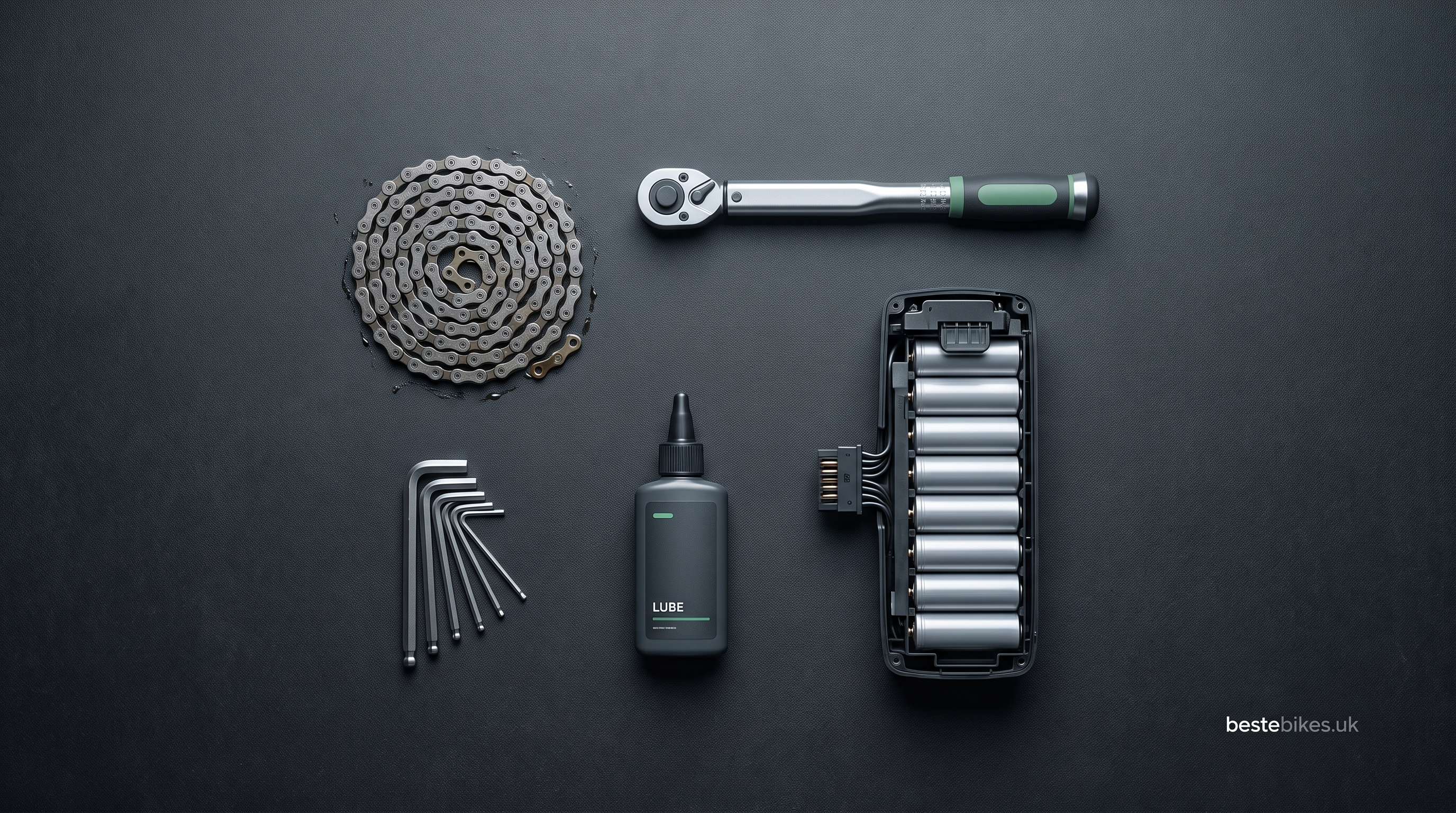
A well-kept eBike needs five things checked on a routine: tyre pressure, chain lubrication, brake pads, battery charge habits, and bolt torque — each takes minutes, and together they are what separates a bike that still rides like new after three years from one that needs an expensive motor or battery replacement. None of it requires a workshop. A pump, a multitool, a bottle of chain lube and twenty minutes a month cover most of it, and the remainder is really just knowing when to hand the electrical side to someone qualified. This guide sets out the routine in the order it matters, with the models on this site that make each job easier or harder.
Build Tyre Pressure Into Every Ride
Correct tyre pressure protects the wheel, the range readout and the ride quality all at once, and it takes fifteen seconds with a pressure gauge. Most eBike tyres list a pressure range in PSI on the sidewall — running near the top of that range cuts rolling resistance, which is where a chunk of "the range doesn't match the claimed figure" complaints actually come from, alongside the usual gap between a manufacturer's test conditions and a real commute covered in our range guide. A soft tyre also flexes more at the rim, which is how pinch flats happen on potholed UK roads. Fat-tyre bikes such as the Himiway D5 2.0 run lower pressures for grip and comfort, so check the specific sidewall figure rather than assuming a road-bike number.
Keep the Drivetrain Clean, Dry and Lubricated
A clean, lubricated chain is the single cheapest thing that extends a drivetrain's life, because grit mixed with old lube turns into a grinding paste that wears the chain, cassette and chainring together. Wipe the chain with a dry cloth after wet rides, apply a few drops of a proper bike-specific lubricant (a wet lube for UK winters, a dry lube for summer), then wipe off the excess so it doesn't attract more road grime. On a mid-drive bike such as the Engwe L20 3.0 Pro this matters even more, because the motor pushes its power straight through that same chain rather than through a separate hub — a neglected chain there is doing double duty and wearing twice as fast.
Charge the Battery for Longevity, Not Just for a Full Bar
The single habit with the biggest effect on long-term battery health is avoiding the extremes: don't routinely run the pack down to empty, and don't leave it sitting at 100% on the charger for days at a time. Lithium cells measurably prefer living between roughly 20% and 80% charge for day-to-day storage, which is why several manufacturers now build a charge-limit or storage-mode option into their companion apps. If the bike is off the road for more than a few weeks — over a UK winter, say — store the battery at around half charge in a cool, dry spot rather than in a freezing shed or a hot conservatory; manufacturers' own guidance consistently names both temperature extremes as accelerators of capacity loss. Always use the charger supplied with the bike: chargers are matched to a specific voltage and battery chemistry, and a mismatched one is one of the few things that can damage a pack outright.
Check Brakes Before Every Ride That Matters
A quick lever check — firm bite, no grinding, no metal-on-metal — takes seconds and catches the one component where a fault genuinely isn't a "get to it eventually" job. Hydraulic disc brakes, which is what most eBikes on this site ship with, are largely self-adjusting as the pads wear and need comparatively little attention beyond a periodic pad-thickness check and an occasional bleed as the fluid ages. Mechanical (cable) disc brakes need more hands-on care, because the pads close in on the rotor as they wear and the cable tension has to be taken up manually to keep the lever feel consistent.
| Brake type | Typical upkeep | Example |
|---|---|---|
| Hydraulic disc | Self-adjusting; check pad thickness periodically, bleed occasionally | ADO Air 28 Pro, Fiido M1 Pro |
| Mechanical disc | Manual cable tension and pad adjustment as they wear | Cyrusher Loop 2.0, Engwe EP-2 Boost |
Re-Torque the Bolts After the First Few Rides
Every bolted joint on a new bike — stem, seatpost clamp, pedals, rack, kickstand — settles slightly once it takes real-world vibration and weight, so a torque check after the first week of riding is standard practice, not a symptom of a badly built bike. Most manufacturers print the correct torque figures in Newton-metres on the frame near each bolt or in the manual, and a compact torque wrench is a worthwhile one-off purchase for anyone keeping a bike long-term, since overtightening a carbon or alloy component can crack it just as reliably as a loose one can rattle loose. Heavier cargo and utility builds, like the ADO Oasis One, carry more load on the rack and kickstand mounts specifically, so those are worth a specific check rather than a general once-over.
Protect Against UK Weather Between Rides
A quick wipe-down after a wet or gritty ride does more for long-term reliability than any single product, because road salt and grit are what actually corrode exposed bolts, chains and connectors over a British winter. Rinsing with a hose is fine; a pressure washer aimed directly at the motor, battery housing or electrical connectors is not, and is explicitly warned against in most manufacturer manuals because it can force water past seals rated for rain, not a jet. Drying the frame and chain before putting the bike away, and keeping electrical contacts free of standing moisture, covers most of what winter riding throws at it.
Know Which Jobs Need a Specialist
Anything that opens the motor casing, the battery pack itself, or the wiring between them is a job for a qualified eBike technician, not a home fix — these are sealed, high-current systems, and opening one can void the warranty even before it introduces a safety risk. The same goes for diagnosing a torque or cadence sensor that's reading incorrectly, since recalibrating one properly usually needs the manufacturer's own diagnostic tool. Most UK bike shops now handle eBike servicing, and it's worth confirming a shop has experience with your specific motor brand before booking in, since hub and mid-drive systems from different manufacturers aren't interchangeable in how they're serviced.
| Task | Who does it |
|---|---|
| Tyre pressure, chain lube, wipe-downs | Owner, every ride or week |
| Brake pad check, bolt torque check | Owner, monthly or after the first week |
| Hydraulic brake bleed, gear tuning | Owner with experience, or a bike shop annually |
| Motor, battery pack, sensor diagnostics | Manufacturer-approved technician only |
None of this is complicated once it's a habit rather than a one-off task, and the payoff is the whole reason to buy an eBike in the first place: a motor and battery that still perform the way they did on day one, years into ownership.