
More specs
- Sensor
- Cadence sensor
- Brakes
- Tektro Aries disc
- Motor (continuous)
- 250 W
- Claimed top speed
- 25 km/h
- Payload
- 150 kg
- Road-legal status
- Within limit*
5 active Himiway models compared, from €1,699 to €2,799.
Prices quoted in the written comparison below are the UK figures from our reference catalogue. The prices on each model card, and the price you will see when you follow a buy link, are the ones that store charges in its own currency.
Best overall
€2,599
The only Himiway with a dual cadence-and-torque sensor, on a full-suspension fat-tyre frame with hydraulic discs, an 8-speed drivetrain and turn indicators. It is the one model here that lets you choose how the assistance responds.
Drawback: At 41.7 kg it is the second-heaviest bike in the range, and its stated battery is smaller than the 960 Wh packs on the Zebra, Big Dog and C5 Ultra.

Best value
€2,799
Joint-cheapest in-stock Himiway, with the 960 Wh battery, 86 Nm motor, hydraulic discs and a 181 kg payload rating — the same headline hardware as dearer bikes in the range. Note it is sold in two sensor variants, torque or cadence; check which you are ordering.
Drawback: A high-step frame only, and 35.8 kg. Himiway list a half-twist throttle in its specification, which needs its own approval to be legal on a UK road.

Best for hills
€2,799
The only mid-drive Himiway and, at 120 Nm, the most torque of any Himiway, though not of any bike here — two mid-drives elsewhere in the catalogue reach 160 Nm — driving through a 9-speed drivetrain rather than the hub. It is also the only Himiway not on fat tyres, so it rolls like a bike rather than a moped.
Drawback: The most expensive bike in the range.
Decision fields only — best use, price, weight, battery, sensor, brakes, motor rating, claimed top speed, payload and road-legal status. Full specifications live on each bike's own page.

| Model | Best use | Price | Weight | Battery | Sensor | Brakes | Motor (continuous) | Claimed assist cut-off | Payload | Pedelec power check |
|---|---|---|---|---|---|---|---|---|---|---|
| Himiway Escape Pro | Moped-style cruiser, cadence sensor, mechanical brakes | €1,699 | 42 kg | 840 Wh | Cadence sensor | Tektro Aries disc | 250 W | 25 km/h (15.5 mph) | 150 kg | Within limit* |
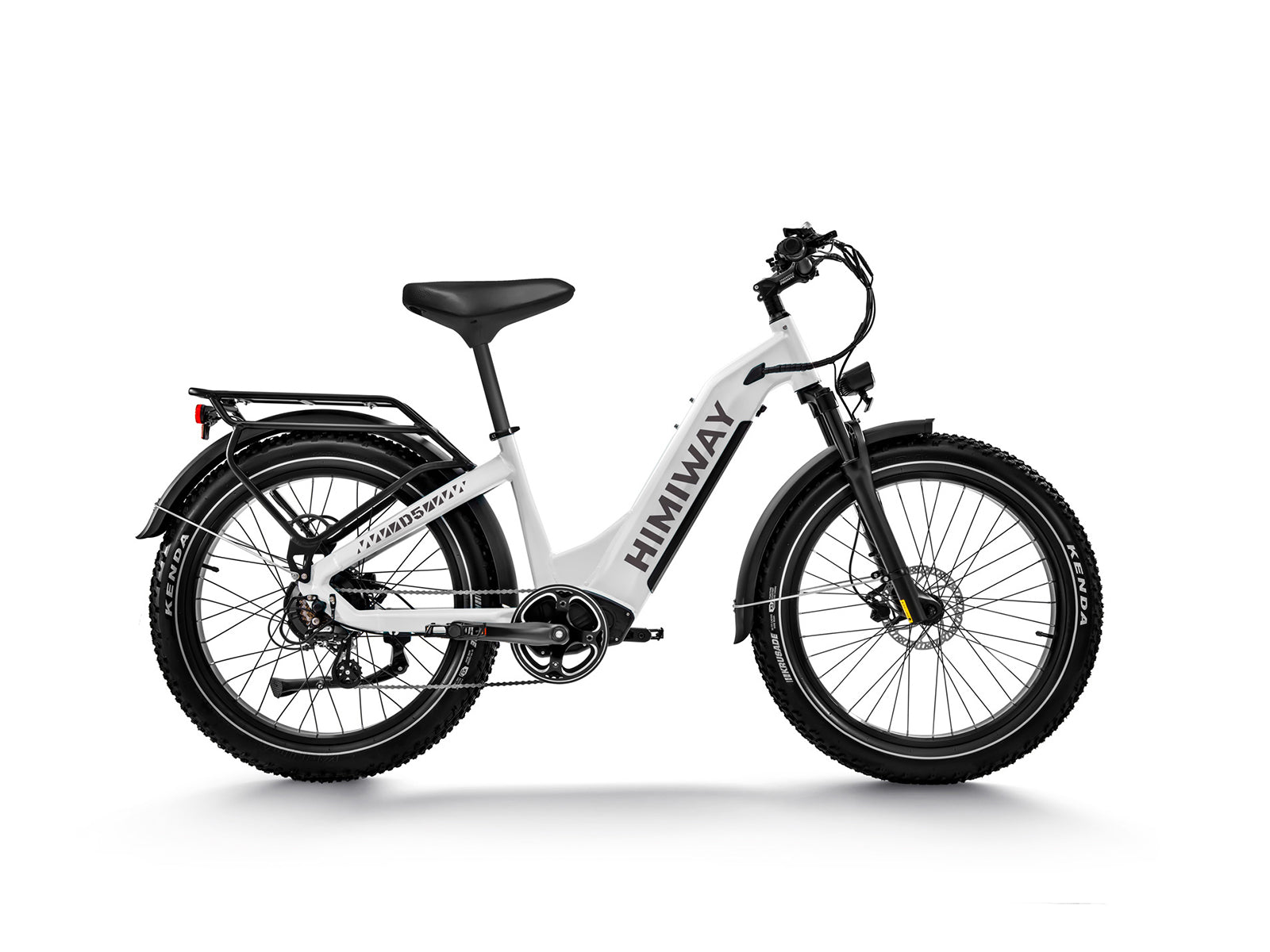
| Himiway D5 (Zebra) | All-terrain fat bike, 960 Wh, highest payload | €2,799 | 35.8 kg | 960 Wh | Torque sensor | Tektro hydraulic disc, 180mm rotors front and rear | 250 W | 25 km/h (15.5 mph) | 181 kg | Within limit* |
| Himiway D5 2.0 | Only dual-sensor Himiway; full suspension, indicators | €2,599 | 41.7 kg | 720 Wh | Hybrid (torque + cadence) | Tektro hydraulic disc (203mm front / 180mm rear) | 250 W | 25 km/h (15.5 mph) | 181 kg | Within limit* |
| Himiway C5 Ultra | Moped-style full-suspension, 960 Wh | €2,799 | 39.9 kg | 960 Wh | Torque sensor | Tektro hydraulic disc, 180mm rotors front and rear | 250 W | 25 km/h (15.5 mph) | 150 kg | Within limit* |
| Himiway A7 Pro | Only mid-drive; 120 Nm, the most torque of any Himiway | €2,799 | 35 kg | 720 Wh | Torque sensor | Shimano hydraulic disc | 250 W | 25 km/h (15.5 mph) | 136 kg | Within limit* |
*Continuous power and top speed are manufacturer-published figures, not independently tested by us. See the EU road legality, model by model below before assuming any model is road-legal as-is.
Same family name, a modest price step apart, and the difference is worth the money for one specific buyer. Both are 26x4.0in fat bikes with hydraulic discs and a 181 kg payload. The Zebra has the bigger 960 Wh battery and is the cheaper of the two; the D5 2.0 costs more for a smaller stated pack but adds full suspension, an 8-speed drivetrain, turn indicators and — the real reason to pay — a dual cadence-and-torque sensor, the only one in the range. If you want to choose how the assistance responds, only the D5 2.0 offers it. If you want the most battery for the least money, the Zebra.
See the full Himiway D5 (Zebra) vs Himiway D5 2.0 head-to-head →The two moped-style Himiways, and the cheaper one is the one to be careful with. The Escape Pro is the cheaper by a clear margin, but it is the only current Himiway with mechanical rather than hydraulic disc brakes, uses a cadence sensor, is the heaviest bike in the range at 42 kg and dates from 2023. The C5 Ultra brings hydraulic discs, a torque sensor, full suspension and a bigger battery for the difference. Unless the Escape Pro's price falls a long way, the C5 Ultra is the better version of the same idea.
See the full Himiway Escape Pro vs Himiway C5 Ultra head-to-head →Himiway sells 5 current models in the EU, spanning €1,699 to €2,799, through uk.himiwaybike.com. This page compares every current model against every other so you can work out which one, if any, is actually the right buy — not just which one is cheapest.
Himiway is the heavy-duty end of this site. Every one of the 5 models has suspension, 4 of 5 run fat tyres, payload ratings run to 181 kg, and three models share a 960 Wh battery — among the largest packs we track. The A7 Pro is the one mid-drive in the range and, at 120 Nm, carries the most torque of any Himiway, though not of any bike here — two mid-drives elsewhere in the catalogue reach 160 Nm. 4 of 5 ship hydraulic disc brakes.
Sensors are the thing to check model by model: only the D5 2.0 carries a dual cadence-and-torque sensor, the Zebra, C5 Ultra and A7 Pro use a torque sensor, and the Big Dog and Escape Pro use a cadence sensor. The Zebra is also sold in two sensor variants, so confirm which one is in the basket. All of them were in stock at our last check.
Where Himiway is a weaker fit: weight and price. These are the heaviest bikes on the site — 35 kg to 42 kg, nothing under 35 kg — and the range starts well above where every other brand here starts. That cheapest model, the Escape Pro, is also the weakest specified: mechanical brakes, a cadence sensor and a 2023 design.
To be ridden as an ordinary bicycle in the EU — no type approval, registration, licence or insurance required — an eBike has to meet the pedelec (EPAC) rules: working pedals, assistance only while you are pedalling, a maximum continuous rated motor output of 250 W, and no motor assistance above 25 km/h. A throttle beyond walk-assist speed takes a bike outside those rules. Individual countries still set their own requirements on things like minimum age, helmets and where you may ride, so check the ones where you ride.
Every one of the 5 active Himiway models we track publishes a continuous motor rating at or below 250 W and a claimed top assisted speed around 25 km/h, consistent with the EU pedelec ceiling on paper. That is manufacturer-published data, not something we have independently tested, and power plus top speed are only two of the requirements — the exact unit sold in your country also needs its markings, and a throttle beyond walk-assist speed takes a bike outside the rules altogether.
| Model | Continuous power | Claimed top assisted speed | Status |
|---|---|---|---|
| Himiway Escape Pro | 250 W | 25 km/h (15.5 mph) | Within limit* |
| Himiway D5 (Zebra) | 250 W | 25 km/h (15.5 mph) | Within limit* |
| Himiway D5 2.0 | 250 W | 25 km/h (15.5 mph) | Within limit* |
| Himiway C5 Ultra | 250 W | 25 km/h (15.5 mph) | Within limit* |
| Himiway A7 Pro | 250 W | 25 km/h (15.5 mph) | Within limit* |
Editorial review: 24 August 2026
What Himiway does well: capacity. Three models carry a 960 Wh battery, payload ratings run to 181 kg, every model has suspension and 4 of 5 are on fat tyres — these are bikes built to carry a heavy rider a long way over bad ground. The A7 Pro's 120 Nm mid-drive is the strongest motor on this site, and 4 of 5 ship hydraulic discs.
Where it compromises: weight and price. Nothing under 35 kg, and the range starts high. Only one model, the D5 2.0, offers the dual sensor that lets a rider choose how assistance responds; two use a cadence sensor. The entry-level Escape Pro is a step down on brakes, sensor and age rather than simply a cheaper Himiway.
Who else to consider: for the dual sensor across a whole range rather than one model, our Cyrusher buying guide — the same heavy fat-tyre idea, generally lighter and cheaper. For something you can actually carry, ADO averages some 17 kg less per bike. More broadly, browse cargo eBikes or fat-tyre eBikes to see the whole field rather than one brand.
Yes — they are the heaviest bikes we list, from 35 kg to 42 kg, and nothing in the range is under 35 kg. That is the trade for the battery capacity and payload ratings they are built around.
The A7 Pro, at 120 Nm, and it is the only mid-drive Himiway. It is not the most on this site, though — two mid-drives elsewhere in our catalogue reach 160 Nm.