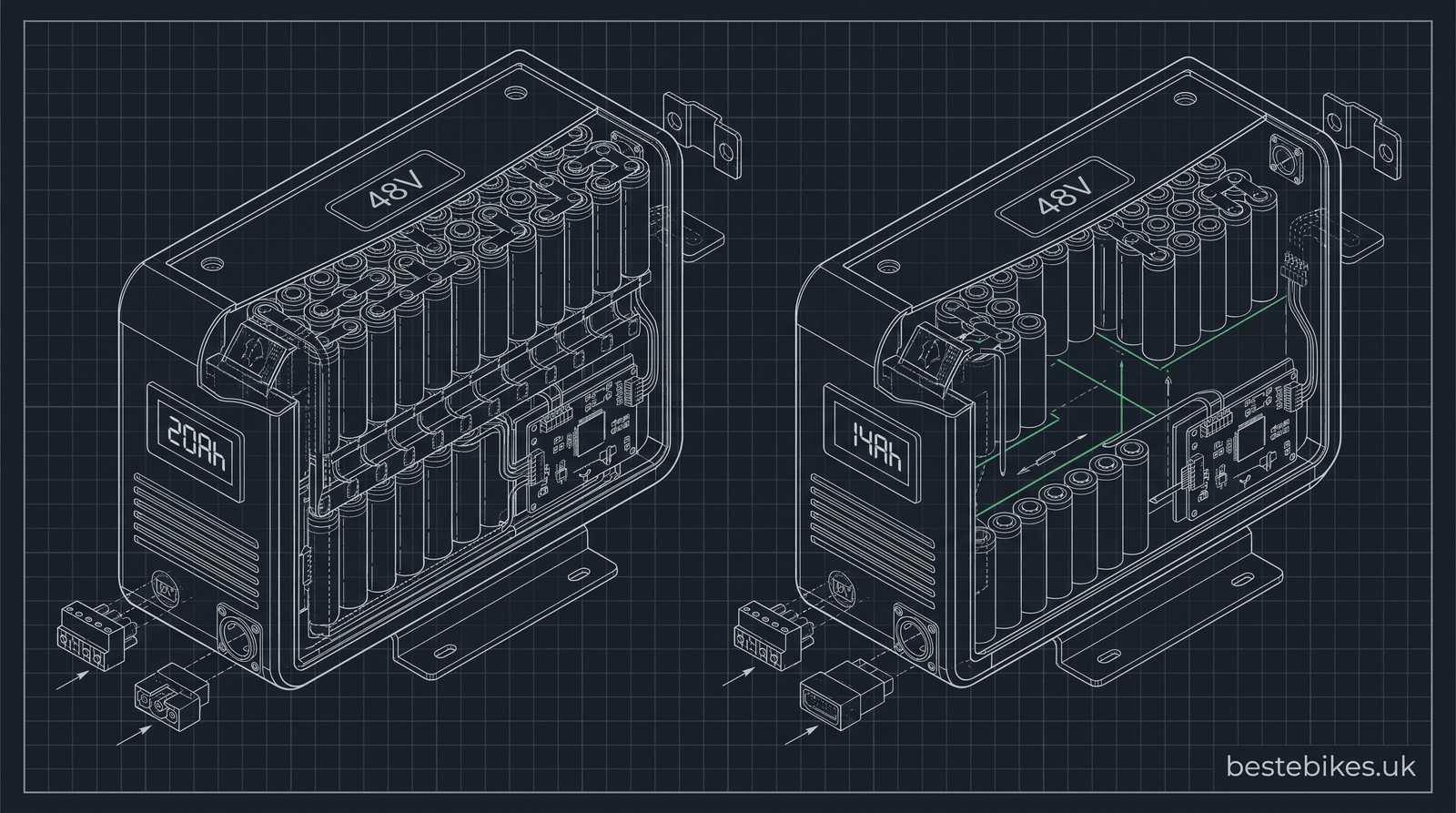
Does the same eBike model have the same specs in every country?
A customer got in touch this year after unboxing an eBike that didn't match the one they'd researched. Same brand, same model name, but the battery inside was rated at roughly half the capacity of the version reviewed online. A model name doesn't guarantee the same battery, motor or spec sheet wherever an eBike is sold — some manufacturers build a genuinely different bike under one name to suit local rules or local costs, so the only figures worth trusting are the ones published on the exact page you're ordering from, not the model name at the top of it.
Why would the same model have a different battery abroad?
It comes down to what each market actually requires. A UK-market bike has to sit inside the EAPC rules — a continuous motor rating of 250W and assistance that cuts out at 15.5mph, set out by the government's EAPC information sheet — while a US-market version of the same bike answers to a different set of rules entirely. Shipping costs, import duty and battery-transport regulations differ by country too, and a smaller cell pack costs less to build, freight and certify. Put those pressures together and a manufacturer has a real incentive to sell two different bikes under one name, describing the smaller-battery version as an updated configuration for local compliance rather than flagging it as a separate product.
None of that is dishonest on its own. The problem is that a YouTube review, a spec sheet shared in a forum, or a friend's bike bought in another country can describe hardware that simply isn't the hardware arriving at your door.
What to check on the page before you order
Four figures tell you almost everything, and every one of them should be on the product page you're actually buying from rather than assumed from the name.
| What to check | Where it's published | Why it matters |
|---|---|---|
| Battery capacity | Voltage (V) and amp-hours (Ah) under the specification list | Multiply the two for the real Wh figure — see our battery guide for the full calculation |
| Motor power | Continuous and peak wattage, usually listed separately | UK rules cap continuous output at 250W; other markets allow higher continuous or peak figures |
| Motor type and torque | Hub or mid-drive, plus torque in Nm | The same model name can switch motor type between regions — see our hub vs mid-drive comparison |
| Claimed range | Manufacturer's stated distance, and any conditions attached to it | A claimed figure assumes ideal conditions; our range guide shows how to adjust it |
Every one of those figures is a manufacturer-published spec, not an independent measurement, and the page should say so plainly. If a listing states a number without saying where it came from, that's worth a direct question to the seller before you order.
How do voltage and amp-hours turn into a range you can trust?
Voltage multiplied by amp-hours gives you watt-hours — the nominal energy stored in the pack. A battery listed at 48V and 25Ah stores roughly 1,200Wh; the same brand's 48V 14Ah pack stores around 670Wh, a little over half. That gap shows up directly in range, in how the bike climbs under load, and in how many charge cycles the battery is likely to see before it's replaced. It's a five-second calculation once you have both numbers, and it turns a marketing name into an actual spec you can compare across two listings side by side.
Does a smaller battery number always mean a worse bike?
Not necessarily, and it's worth saying so. A smaller pack can mean a lighter bike, a lower price, or a version tuned for shorter commutes rather than long weekend rides — some riders would choose it deliberately. The issue isn't which battery is better. It's ordering one size while believing, on the strength of a shared model name, that you're getting the other.
How Best eBikes UK handles the same model sold two ways
Comparisons on this site are built from each manufacturer's own published specifications for the exact version being sold in that market — we don't own, test-ride or store the bikes ourselves. Where a brand offers more than one battery under the same name, that's shown rather than smoothed over: Engwe's LE20 lists its dual-battery option alongside the standard pack, and Himiway's D5 2.0 and Fiido's T3 Max both carry a labelled upgrade battery next to the base figure, so the two configurations sit next to each other rather than behind one shared name. Where a UK and a US listing of the same model carry genuinely different core specs, the newer version stays off the catalogue until both spec sheets have been checked against each other, rather than assuming the model name means the same bike in both markets.
That's the whole discipline: read the number on the page you're ordering from, not the number attached to the name.
Frequently asked questions
Why would a manufacturer sell the same model name with two different batteries?
Different countries set different rules for motor power, battery transport and import duty, and a smaller battery costs less to build, ship and certify. Rather than design a separate model for each market, some manufacturers keep one model name and quietly change the battery, motor tune or components underneath it, describing the change as a configuration update for local compliance.
How do I find the real battery spec for the exact bike I'm ordering?
Open the specification list on the actual product page for your country's store, not a review, forum post or spec sheet from another market. Look for the voltage (V) and amp-hour (Ah) figures together — most manufacturers publish both, and multiplying them gives you the watt-hour capacity you can compare directly against any other listing.
Does a lower amp-hour rating always mean a worse eBike?
No. A smaller battery can mean a lighter bike, a lower price or a shorter intended range, and some riders would pick it on purpose for a short commute. The point isn't that bigger is always better — it's knowing which one you're actually buying before you pay for it.
Can I trust a YouTube review if I'm buying the bike in a different country?
Treat it as a guide to the brand's build quality and general design rather than a guarantee of identical hardware. Compare the reviewer's stated battery, motor and torque figures against the specification list on your own market's product page before assuming they match.
What's the difference between watt-hours, voltage and amp-hours?
Voltage (V) and amp-hours (Ah) are the two figures manufacturers usually publish; multiplying them gives you watt-hours (Wh), the real measure of stored energy. Two batteries can share a voltage and still store very different amounts of energy if their amp-hour rating differs, so always check both numbers rather than one alone.
Does UK law limit how powerful an eBike's battery or motor can be?
UK EAPC rules cap continuous motor output at 250W and assistance at 15.5mph, but they don't set a maximum battery size — a bike can carry a large battery and still stay road-legal, provided the motor's continuous rating and cut-off speed meet the EAPC limits.
What should I do if the spec sheet doesn't match what I expected, before I complete an order?
Contact the seller directly and ask them to confirm the battery voltage, amp-hour rating and motor wattage in writing for the specific version they're shipping to your address, before you pay. A seller unable or unwilling to confirm those figures in writing is telling you something worth listening to.