Hub vs Mid-Drive E-Bikes: Which Motor Is Right for You? (2026)
If you've spent any time agonising over which e-bike to buy, you'll have run into the great debate sooner or later: hub motor or mid-drive? It's the question I get asked more than any other, usually somewhere between "how far will it really go?" and "is it legal?". And honestly, it's the right question to be asking, because the motor is the single biggest factor in how a bike actually feels to ride. So pour a brew, and let me walk you through what I've learned after years of riding both up and down the UK.
The Difference in Plain English
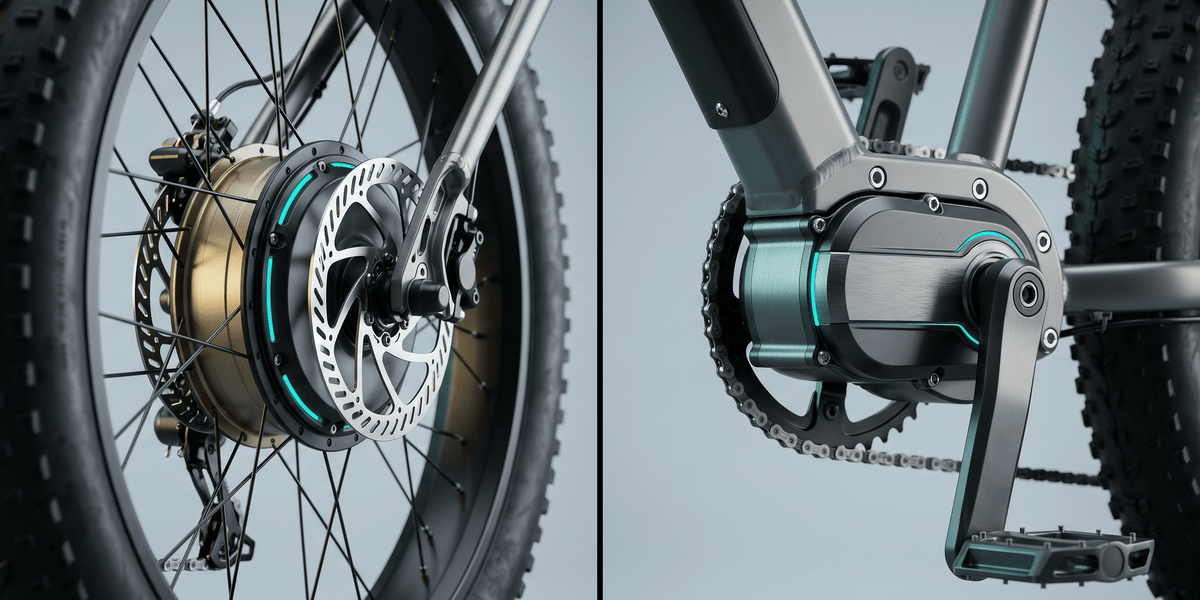
A hub motor lives inside the centre of one of your wheels — almost always the rear on the bikes worth buying. It spins the wheel directly, like an invisible hand giving the tyre a push. A mid-drive motor sits down at the bottom bracket, right where the pedals and chainring meet, and it drives the chain instead of the wheel. That one difference in location changes absolutely everything about how the bike behaves.
Here's the mental model I use: a hub motor pushes the bike, while a mid-drive motor helps you pedal. It sounds like a subtle distinction, but you feel it within the first ten metres.
How They Feel on the Road
Hub motors deliver power in a smooth, slightly detached way. You twist the throttle or turn the pedals, and the bike surges forward like it's being towed. It's effortless and, frankly, a lot of fun on the flat. Most of the value-packed UK bikes use rear hub motors because they're cheaper to build, dead reliable, and brilliant for commuting on relatively level ground.
Mid-drives feel completely different. Because the motor pushes through your chain and gears, it multiplies its power exactly the same way your legs do. Drop into a low gear at the bottom of a brutal Yorkshire climb and a good mid-drive will haul you up like the hill simply isn't there. The power feels connected to your pedalling — more like a very, very strong version of your own legs than a separate engine.
Hub vs Mid-Drive: The Honest Comparison
| Factor | Hub Motor | Mid-Drive Motor |
|---|---|---|
| Hill climbing | Good on gentle/moderate hills | Excellent — uses your gears |
| Ride feel | Smooth "push", great on the flat | Natural, connected to pedalling |
| Weight balance | Rear-heavy | Low & central — best handling |
| Reliability | Very high — fewer moving parts | High, but more drivetrain wear |
| Maintenance cost | Low | Higher (chains/cassettes wear faster) |
| Throttle (where legal) | Usually available | Often pedal-assist only |
| Price | Better value | Premium |
| Puncture repair | Fiddlier (motor in the wheel) | Standard wheel — easy |
Climbing: Where Mid-Drives Really Shine
This is the headline. If you live somewhere flat-ish — much of East Anglia, say — a hub motor will serve you beautifully and save you a few hundred quid. But if your daily ride involves proper gradients, a mid-drive is transformative. Because it feeds power through the cassette, you can gear down and let the motor spin in its happy zone, producing far more usable torque at the wheel than the raw figures suggest.
Look at the torque numbers across some of the bikes we've reviewed and you start to see the story:
| Bike | Motor Type | Torque | Weight | Price |
|---|---|---|---|---|
| Himiway A7 Pro | Mid-Drive | 130 Nm | 35.0 kg | £2,399 |
| Engwe LE20 | Mid-Drive | 100 Nm | 36.8 kg | £1,199 |
| Engwe N1 Pro | Mid-Drive | 80 Nm | 19.0 kg | £1,599 |
| Cyrusher Roam | Hub | 95 Nm | 37.0 kg | £1,499 |
| Himiway D5 2.0 | Hub | 90 Nm | 41.7 kg | £1,999 |
| Engwe EP-2 3.0 Boost | Hub | 75 Nm | 32.3 kg | £1,099 |
Now, a word of caution on those numbers: torque figures across hub and mid-drive bikes aren't directly comparable. A mid-drive quoting 100 Nm multiplies that through your gears, so its real climbing ability dwarfs a hub motor quoting a similar figure. The Himiway A7 Pro at a monstrous 130 Nm will simply embarrass almost anything on a steep hill. Don't read the spec sheet as gospel — read it as a rough hint.
Handling and Weight
Because a mid-drive carries its motor low and central, the bike feels balanced and planted, especially in corners. Hub-motor bikes carry that lump out at the back wheel, which can make the rear feel a touch heavy when you're manhandling the bike up a kerb or onto a train. The featherweight Engwe N1 Pro at just 19 kg shows how a clever mid-drive layout keeps weight down and centred — a joy to live with day to day.
Reliability and Running Costs
Here's where hub motors quietly win back a lot of ground. A rear hub motor is a beautifully simple thing — a sealed unit with almost nothing to go wrong, and it doesn't put any extra strain on your chain or gears. Mid-drives, by funnelling all that power through the drivetrain, chew through chains and cassettes noticeably faster. If you're the sort who'd rather ride than wield a chain-wear tool, that matters.
Punctures are the other consideration. Getting a rear wheel off a hub-motor bike means dealing with motor cables, which is more of a faff at the roadside. A mid-drive runs an ordinary wheel, so a flat is just a flat. The brilliant-value Engwe EP-2 3.0 Boost is a classic dependable hub commuter — set-and-forget reliability for just over a grand.
So Which Should You Buy?
Let me make this simple, because I genuinely don't think one is "better" — they're better at different things.
Buy a hub motor if: you mostly ride on flat-to-moderate terrain, you want the best value for money, you love an easy throttle for pulling away at lights, and you want the lowest possible maintenance. For a huge chunk of UK commuters and leisure riders, a quality hub bike like the Cyrusher Roam or Himiway D5 2.0 is all the bike they'll ever need.
Buy a mid-drive if: you face proper hills regularly, you want the most natural, bike-like ride feel, you care about handling and weight balance, and you don't mind paying a premium and servicing the drivetrain a little more often. For the hills of Wales, the Peak District or anywhere your knees currently dread, a mid-drive like the Engwe LE20 or the range-topping Himiway A7 Pro is worth every penny.
My Honest Take
If money were no object and I lived somewhere hilly, I'd take a mid-drive every time — that connected, "the hill just vanished" sensation never gets old. But I'll let you in on a secret: for my flat daily commute, I happily ride a hub-motor bike, because it's cheaper, near enough bulletproof, and does the job with a grin. The right answer isn't about which motor is superior on paper. It's about matching the motor to the roads outside your front door. Get that right, and you'll love whichever you choose.
Have a browse through our full range of reviewed e-bikes and use the motor type as your starting filter — your local hills will tell you the rest.