
More specs
- Sensor
- Torque sensor
- Brakes
- Hydraulic disc
- Motor (continuous)
- 250 W
- UK top speed
- 25 km/h
- Payload
- 120 kg
- Road-legal status
- Within limit*
15 active Engwe models compared, from £799 to £1,699.

Best all-rounder
£1,399
The most-viewed model in our Engwe data, and the only folding model in the range with a mid-drive motor — 100 Nm from a Mivice motor, a 720 Wh pack, and Shimano 7-speed gearing that lets the motor use the drivetrain efficiently on hills.
Drawback: It's one of the pricier folding models in the range, and mid-drive motors put more wear through the chain and cassette than a hub motor does — budget for that upkeep.

Best for portability
£999
At 19.4 kg it's easily the lightest folder Engwe sells, triple-folding small enough for a train or a lift, and the battery lifts out into its own carry bag to charge at a desk.
Drawback: That portability costs range and comfort: the smallest battery in the current range, only 40 Nm of torque, and no suspension at all, so it's happiest on smoother roads.

Best value
£899
The cheapest folding Engwe model, and it still gets the torque sensor plus a genuinely usable battery rated by Engwe to 120 km.
Drawback: The savings show up in the spec sheet: no front or rear suspension and mechanical rather than hydraulic disc brakes, a step down from the boosted models nearby in price.
Decision fields only — best use, price, weight, battery, sensor, brakes, motor rating, claimed top speed, payload and road-legal status. Full specifications live on each bike's own page.




| Model | Best use | Price | Weight | Battery | Sensor | Brakes | Motor (continuous) | Claimed assist cut-off | Payload | EAPC power check |
|---|---|---|---|---|---|---|---|---|---|---|
| Engwe P275 SE | Budget upright city commuter | £799 | 24.4 kg | 468 Wh | Torque sensor | Hydraulic disc | 250 W | 25 km/h (15.5 mph) | 120 kg | Within limit* |
| Engwe EP-2 Boost | Cheapest entry point | £899 | 30 kg | 624 Wh | Torque sensor | Mechanical disc 180mm front + rear | 250 W | 25 km/h (15.5 mph) | 150 kg | Within limit* |
| Engwe Zip | Ultra-portable train or office commute | £999 | 19.4 kg | 360 Wh | Torque sensor | Hydraulic disc | 250 W | 25 km/h (15.5 mph) | 120 kg | Within limit* |
| Engwe L20 3.0 Boost | All-round folding step-through | £1,049 | 33.2 kg | 648 Wh | Torque sensor | Hydraulic disc 180mm | 250 W | 25 km/h (15.5 mph) | 150 kg | Within limit* |
| Engwe Engine X | Budget full-suspension fat-tyre folder | £1,049 | 31.7 kg | 624 Wh | — | 160 mm front & rear mechanical disc | 250 W | 25 km/h (15.5 mph) | 150 kg | Within limit* |
| Engwe O20 Boost | Comfort step-through, big battery | £1,099 | 25 kg | 720 Wh | Torque sensor | Hydraulic disc, double piston | 250 W | 25 km/h (15.5 mph) | 150 kg | Within limit* |
| Engwe EP-2 3.0 Boost | Folding commuter with regenerative braking | £1,099 | 32.3 kg | 648 Wh | Torque sensor | Hydraulic disc 180mm | 250 W | 25 km/h (15.5 mph) | 150 kg | Within limit* |
| Engwe L20 Boost | Step-through fat-tyre with basket | £1,099 | 34 kg | 624 Wh | Torque sensor | 160 mm front & rear mechanical disc | 250 W | 25 km/h (15.5 mph) no throttle | 120 kg | Within limit* |
| Engwe N1 Air | Lightest carbon-frame option |
£1,199
Out of stock · |
16.4 kg | 360 Wh | Torque sensor | Mechanical disc 160mm | 250 W | 25 km/h (15.5 mph) | 120 kg | Within limit* |
| Engwe LE20 | Cargo hauling and heavy loads |
£1,199
Out of stock · |
36.8 kg | 922 Wh | Torque sensor | Hydraulic disc 180mm | 250 W | 25 km/h (15.5 mph) | 200 kg | Within limit* |
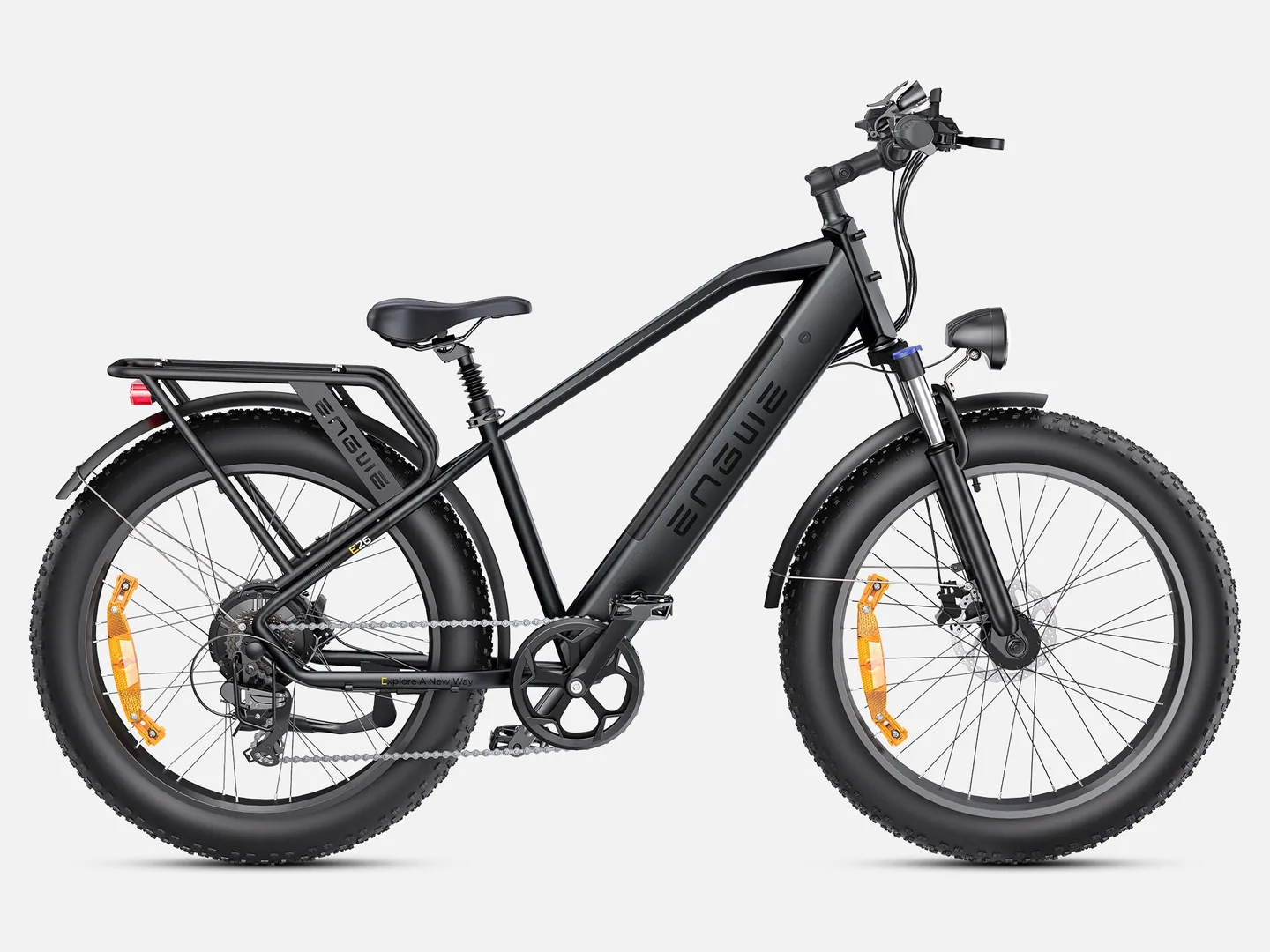
| Engwe E26 | All-terrain fat-tyre cruiser | £1,299 | 33.5 kg | 768 Wh | Torque sensor | Hydraulic disc 180mm | 250 W | 25 km/h (15.5 mph) | 150 kg | Within limit* |
| Engwe Engine Pro 2.0 | Full-suspension fat-tyre folder | £1,299 | 31.6 kg | 768 Wh | Torque sensor | 160 mm hydraulic disc | 250 W | 25 km/h (15.5 mph) PAS 5 | 150 kg | Within limit* |
| Engwe L20 3.0 Pro | Mid-drive folder for hills and long range | £1,399 | 32.8 kg | 720 Wh | Torque sensor | Hydraulic disc 180mm | 250 W | 25 km/h (15.5 mph) | 150 kg | Within limit* |
| Engwe N1 Pro | Lightweight carbon mid-drive |
£1,599
Out of stock · |
19 kg | 360 Wh | Torque sensor | Shimano hydraulic disc 160mm | 250 W | 25 km/h (15.5 mph) | 120 kg | Within limit* |
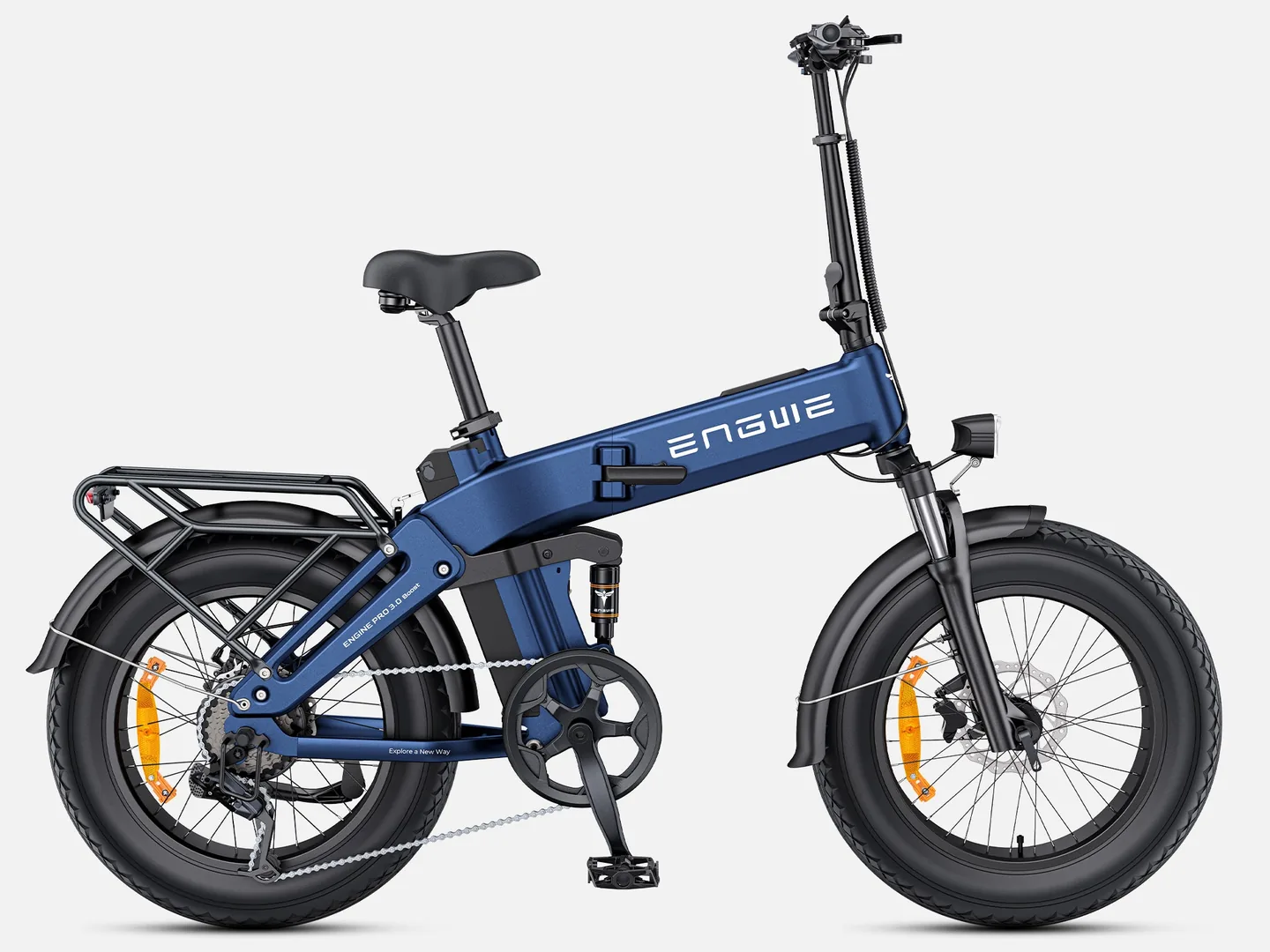
| Engwe Engine Pro 3.0 Boost | Full-suspension folder with anti-theft tracking | £1,699 | 34.7 kg | 720 Wh | Torque sensor | Hydraulic disc | 250 W | 25 km/h (15.5 mph) | 150 kg | Within limit* |
*Continuous power and top speed are manufacturer-published figures, not independently tested by us. See the UK road legality, model by model below before assuming any model is road-legal as-is.
Best upright commuter
Dutch-style geometry and 27.5in wheels for an upright riding position, plus a front basket mount — a genuinely different shape to the fat-tyre-folder-heavy rest of the range.
Drawback: Battery capacity and torque are both modest next to the fat-tyre models in the range, so it suits flatter commutes better than hilly ones.
Best for heavy loads
A 200 kg payload rating — the highest in the range by some margin — a 100 Nm mid-drive motor and the biggest single battery Engwe sells.
Drawback: It's also the heaviest bike here, and it was out of stock at our last check — confirm current availability before you commit to it as a plan.
Choose the Zip if getting the bike through doors, up stairs or onto a train matters more than outright range — its triple-fold and low weight are in a different class to the rest of the lineup. Choose the L20 3.0 Pro if you'd rather carry more bike in exchange for a mid-drive motor, a bigger battery and genuinely long range.
See the full Engwe Zip vs Engwe L20 3.0 Pro head-to-head →Choose the EP-2 Boost if budget is the priority and you mostly ride smooth tarmac. Choose the L20 3.0 Boost if you want dual suspension and hydraulic brakes for the extra outlay, especially on rougher surfaces.
See the full Engwe EP-2 Boost vs Engwe L20 3.0 Boost head-to-head →Choose the P275 SE for solo commuting on tarmac — it's the lighter, cheaper, upright option. Choose the LE20 if you regularly carry heavy loads: its payload rating and mid-drive motor are built for exactly that.
See the full Engwe P275 SE vs Engwe LE20 head-to-head →Engwe is one of the 7 brands we track, with 15 active models in the UK, spanning £799 to £1,699. Its bikes are designed and manufactured in China (per our catalogue's brand record) and sold into the UK through uk.engwe.com. This page compares every current model against every other so you can work out which one, if any, is actually the right buy — not just which one is cheapest.
14 of the 15 Engwe models currently listed here use a torque sensor rather than a simpler cadence sensor, and published payload ratings range from 120 kg to 200 kg where stated — the LE20 is the only current 200 kg model — genuinely high figures that suit heavier riders or a loaded rack. Every model we checked is recorded with free UK delivery.
Engwe suits you if you want that torque-sensor feel and strong payload capacity, and don't mind a bit of heft: 10 of the 15 current models weigh 30 kg or more, which is normal for a fat-tyre folder but still a lot to lift into a car boot or up a flight of stairs — only the carbon-fibre N1 Air/N1 Pro pair and the steel-framed Zip get meaningfully under 20 kg, and each gives up battery capacity or suspension to get there.
Engwe is a worse fit if you want a genuinely light bike as your default, or need to buy today rather than shop around: 3 of the 15 active models were out of stock at our last price check, so the specific model you land on may not be the one available this week. 4 models in the range also still use mechanical rather than hydraulic disc brakes — a real step down from the rest of the lineup.
To be ridden as an ordinary bicycle on a public road or cycle path in Great Britain — no licence, registration, tax or insurance required — an eBike has to meet the Electrically Assisted Pedal Cycle (EAPC) rules: working pedals, a maximum continuous rated motor output of 250 W, and no motor propulsion above 15.5 mph (25 km/h). A throttle, if fitted, can need separate type-approval to keep that treatment. This is Great Britain guidance specifically; Northern Ireland publishes separate rules that this page does not cover.
Every one of the 15 active Engwe models we track publishes a continuous motor rating at or below 250 W and a claimed top assisted speed around 25 km/h (15.5 mph), consistent with the EAPC ceiling on paper. That is manufacturer-published data, not something we have independently dyno-tested, and power plus top speed are only two of the requirements — the exact UK unit also needs its statutory markings and, if it has a throttle, the right approval for it. Engwe's own spec sheets explicitly state "no throttle" for one model (L20 Boost); we cannot confirm the presence or absence of a throttle on the others from the data available, so check the current listing and manual for the specific bike before assuming either way.
| Model | Continuous power | Claimed top assisted speed | Status |
|---|---|---|---|
| Engwe P275 SE | 250 W | 25 km/h (15.5 mph) | Within limit* |
| Engwe EP-2 Boost | 250 W | 25 km/h (15.5 mph) | Within limit* |
| Engwe Zip | 250 W | 25 km/h (15.5 mph) | Within limit* |
| Engwe L20 3.0 Boost | 250 W | 25 km/h (15.5 mph) | Within limit* |
| Engwe Engine X | 250 W | 25 km/h (15.5 mph) | Within limit* |
| Engwe O20 Boost | 250 W | 25 km/h (15.5 mph) | Within limit* |
| Engwe EP-2 3.0 Boost | 250 W | 25 km/h (15.5 mph) | Within limit* |
| Engwe L20 Boost | 250 W | 25 km/h (15.5 mph) no throttle | Within limit* |
| Engwe N1 Air | 250 W | 25 km/h (15.5 mph) | Within limit* |
| Engwe LE20 | 250 W | 25 km/h (15.5 mph) | Within limit* |
| Engwe E26 | 250 W | 25 km/h (15.5 mph) | Within limit* |
| Engwe Engine Pro 2.0 | 250 W | 25 km/h (15.5 mph) PAS 5 | Within limit* |
| Engwe L20 3.0 Pro | 250 W | 25 km/h (15.5 mph) | Within limit* |
| Engwe N1 Pro | 250 W | 25 km/h (15.5 mph) | Within limit* |
| Engwe Engine Pro 3.0 Boost | 250 W | 25 km/h (15.5 mph) | Within limit* |
Official Great Britain EAPC guidance (GOV.UK) · Northern Ireland guidance (nidirect) — different rules, not covered above.
Editorial review: 24 August 2026
What Engwe does well: a torque sensor on most current models, not just the flagship ones — unusual at the price points near the bottom of this range. Payload ratings that are consistently high across the whole lineup, useful for heavier riders or a loaded rack. 4 current models charge from empty in 1.5h or less, well ahead of the 7h some older models in our data still show.
Where it compromises: kerb weight is the recurring trade-off — 10 of the 15 current models sit at 30 kg or more, topping out around 36.8 kg for the heaviest, and only the carbon N1 pair or the steel Zip get meaningfully lighter, each by giving something else up. Brake spec is not consistent across the range: 4 current models still ship with mechanical rather than hydraulic disc brakes. And stock fluctuates — 3 of the 15 models we track were unavailable at our last check, so treat any specific model as provisional until you have confirmed it is actually buyable today.
Who else to consider: if a lighter kerb weight matters more to you than payload capacity, it is worth comparing Engwe against the rest of our catalogue rather than assuming it is the only option — browse folding eBikes, lightweight eBikes or eBikes under £1,000 to see the full field, not just this one brand.
Most of the current range does, and most have hydraulic disc brakes too. The range is broad, so check the individual model — Engwe sell everything from sub-16 kg folders to 36 kg fat-tyre bikes.
The folding models are the strongest case: more than half the current range folds, and the lightest is under 16 kg, which matters if you carry it on a train or up stairs. Check the folded dimensions as well as the weight.
The mid-drive models, at 100 Nm. Engwe run three mid-drives in the current range; the rest are hub motors, which cost less and keep motor force out of the drivetrain.