
More specs
- Sensor
- Torque sensor
- Brakes
- Hydraulic disc (ADO Brake System 3.0)
- Motor (continuous)
- 250 W
- UK top speed
- 25 km/h
- Payload
- 150 kg
- Road-legal status
- Within limit*
13 active ADO models compared, from £999 to £1,999.

Best all-rounder
£1,599
A step-through frame, a Bafang 2-speed auto-shifting hub with a torque sensor, adjustable front suspension with a lockout, and the option to bolt on a second battery for another ~40 km of range when you need it — a sensible middle ground rather than a bike built around one specialism.
Drawback: That second battery is a paid extra, not standard — the "up to 100 km (+40 km dual-battery)" headline figure needs you to buy the extender to actually hit it. There is also no rear suspension.

Best value
£1,299
ADO's cheapest current model, and it still gets a torque sensor and hydraulic disc brakes rather than a stripped-down spec to hit the price — genuinely consistent equipment, not a bait model.
Drawback: The lowest torque rating in the range at 37 Nm (everything else is 40 Nm or more), and at 23.7 kg it is heavier than several models costing £400 more, with no folding hinge.

Best for portability
£1,999
A 16.2 kg carbon-fibre folding frame — easily the lightest bike ADO sells — with NFC power-on in 1.7 seconds and built-in anti-theft GPS, aimed squarely at train or office commuting.
Drawback: It's also the most expensive ADO model at £1,999, and the trade-off for the weight saving shows up in range: ADO claims up to 80 km, against 100 km for most of the mid-range Air models.
Decision fields only — best use, price, weight, battery, sensor, brakes, motor rating, claimed top speed, payload and road-legal status. Full specifications live on each bike's own page.

Step-through all-rounder with optional dual-battery range extension
£1,599 · Out of stock
25 kg · 370 Wh


700c road-wheel commuter, 2-speed auto-shift hub
£1,599 · Out of stock
18.5 kg · 360 Wh


Folding commuter with an NFC smart meter and 3-speed hub
£1,799
20 kg · 346 Wh
700c road-wheel commuter, 3-speed hub for easier hill starts
£1,799 · Out of stock
18.5 kg · 360 Wh

Lightest and priciest ADO — carbon folder for train or office commutes
£1,999
16.2 kg · 370 Wh
| Model | Best use | Price | Weight | Battery | Sensor | Brakes | Motor (continuous) | Claimed assist cut-off | Payload | EAPC power check |
|---|---|---|---|---|---|---|---|---|---|---|
| ADO Oasis One | Comfort step-through, biggest battery and payload in the range | £999 | 37.5 kg | 720 Wh | Torque sensor | Hydraulic disc (ADO Brake System 3.0) | 250 W | 25 km/h (15.5 mph) | 150 kg | Within limit* |
| ADO Air 20s 2026 | Compact folder with NFC display and integrated rear rack | £1,299 | 18 kg | 370 Wh | Torque sensor | Hydraulic disc | 250 W | 25 km/h (15.5 mph) | — | Within limit* |
| ADO Air 28 | Cheapest entry point, still torque-sensor equipped | £1,299 | 23.7 kg | 370 Wh | Torque sensor | Hydraulic disc | 250 W | 25 km/h (15.5 mph) | — | Within limit* |
| ADO Air 20 Pro | Folding commuter, lightest of the 20-inch folders | £1,499 | 21 kg | 346 Wh | Torque sensor | Hydraulic disc 160mm | 250 W | 25 km/h (15.5 mph) | 120 kg | Within limit* |
| ADO Air One Pro | Step-through all-rounder with optional dual-battery range extension |
£1,599
Out of stock · |
25 kg | 370 Wh | Torque sensor | Hydraulic disc | 250 W | 25 km/h (15.5 mph) | 150 kg | Within limit* |
| ADO Air 20 Ultra V2025 | — | £1,599 | 22 kg | 370 Wh | Torque sensor | Hydraulic disc | 250 W | 25 km/h (15.5 mph) | 120 kg | Within limit* |
| ADO Air 28 Pro | 700c road-wheel commuter, 2-speed auto-shift hub |
£1,599
Out of stock · |
18.5 kg | 360 Wh | Torque sensor | Hydraulic disc | 250 W | 25 km/h (15.5 mph) | 120 kg | Within limit* |
| ADO Air 30 Pro | High-step cruiser with an auto-shifting hub motor | £1,699 | 20.5 kg | 370 Wh | Torque sensor | Hydraulic disc | 250 W | 25 km/h (15.5 mph) | — | Within limit* |
| ADO Air 20 Ultra V2026 | Folding commuter with an NFC smart meter and 3-speed hub | £1,799 | 20 kg | 346 Wh | Torque sensor | Hydraulic disc | 250 W | 25 km/h (15.5 mph) | 120 kg | Within limit* |
| ADO Air 28 Ultra | 700c road-wheel commuter, 3-speed hub for easier hill starts |
£1,799
Out of stock · |
18.5 kg | 360 Wh | Torque sensor | Hydraulic disc | 250 W | 25 km/h (15.5 mph) | 120 kg | Within limit* |
| ADO Air 30 Ultra | High-step cruiser, 3-speed hub for easier hill starts | £1,799 | 20.5 kg | 370 Wh | Torque sensor | Hydraulic disc | 250 W | 25 km/h (15.5 mph) | — | Within limit* |
| ADO Air Carbon | — | £1,799 | 15.9 kg | 370 Wh | Torque sensor | Hydraulic disc | 250 W | — | — | Within limit* |
| ADO Air Carbon Pro | Lightest and priciest ADO — carbon folder for train or office commutes | £1,999 | 16.2 kg | 370 Wh | Torque sensor | Tektro hydraulic disc | 250 W | 25 km/h (15.5 mph) | — | Within limit* |
*Continuous power and top speed are manufacturer-published figures, not independently tested by us. See the UK road legality, model by model below before assuming any model is road-legal as-is.
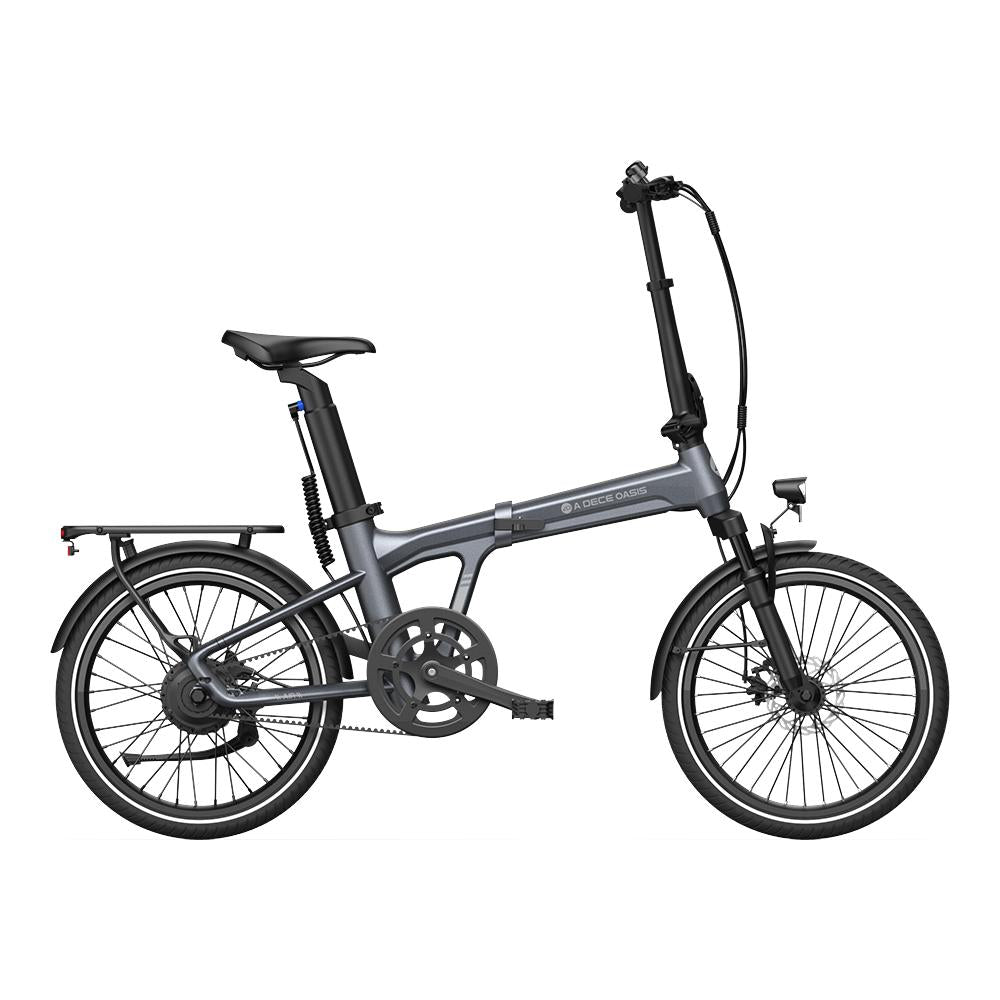
Best for heavy loads or a passenger
The biggest battery ADO sells (720 Wh), the highest torque (55 Nm) and the highest payload rating in the range (150 kg), with Shimano 7-speed gearing rather than a single-speed hub — genuine hill gears for carrying weight.
Drawback: It's also the heaviest bike in the entire range at 37.5 kg — a lot to lift into a car boot or up a flight of stairs — and it doesn't fold.
Best folding commuter, if budget allows
The newest 20-inch folder in the range: a Bafang H730 3-speed auto-shifting hub, 50 Nm of torque and an NFC smart meter for keyless unlock, at a manageable 20 kg.
Drawback: It costs £400 more than the Air 20 Pro for the same 346 Wh battery and the same claimed 100 km range — you are paying for the newer motor and the smart meter, not more range.
These are the same physical bike, not two different ones: identical 18.5 kg step-through frame, 360 Wh battery, 40 Nm torque rating, hydraulic brakes and 100 km claimed range. The Pro uses a Bafang H700 2-speed auto-shifting hub; the Ultra swaps in the H730 3-speed hub, which ADO says gives roughly 24% more torque in low-speed mode for easier hill starts — for £200 more. If hills aren't a problem where you ride, the Pro gets you the same bike for less.
See the full ADO Air 28 Pro vs ADO Air 28 Ultra head-to-head →Same situation as the Air 28 pair: identical 20.5 kg high-step frame, 370 Wh battery, 40 Nm torque and 100 km claimed range. The Ultra's only real difference is the Bafang H730 3-speed hub instead of the Pro's H700 2-speed hub, for £100 more — and at the time of our last check, the Ultra was out of stock while the Pro was available.
See the full ADO Air 30 Pro vs ADO Air 30 Ultra head-to-head →Choose the Air 28 if price is the only thing that matters — it undercuts every other current ADO model and still has a torque sensor and hydraulic brakes. Choose the Air One Pro if you can stretch £400 further: a genuinely auto-shifting hub motor instead of a single-speed one, adjustable front suspension with a lockout, and the option to add a second battery later.
See the full ADO Air 28 vs ADO Air One Pro head-to-head →Choose the Oasis One if payload and comfort come first: the biggest battery, the highest torque and the highest payload rating ADO sells, plus real derailleur gears for hills. Choose the Air One Pro if weight matters more — at 25 kg it's 12.5 kg lighter than the Oasis One, still carries the same 150 kg payload rating, and lets you add range with a second battery instead of carrying one very large one from day one.
See the full ADO Oasis One vs ADO Air One Pro head-to-head →ADO is ranked #3 by model count of the 7 brands we track, with 13 active models in the UK, spanning £999 to £1,999. Its bikes are designed in-house and manufactured in China (per our catalogue's brand record) and sold into the UK through adoebike.co.uk. This page compares every current model against every other so you can work out which one, if any, is actually the right buy — not just which one is cheapest.
The standout fact about ADO's current range: every single one of the 13 models is a hub-motor bike — none use a mid-drive motor. That's a genuine, deliberate difference from brands like Engwe that sell both, not a gap in our data. A hub motor is typically cheaper to service and puts less wear through the chain and cassette than a mid-drive does, but it also means there is no ADO model built specifically for sustained steep-hill climbing the way a mid-drive bike is. Every model also ships with hydraulic disc brakes and a torque sensor — consistent equipment across the whole range, not just the flagships.
Most of the range (10 of 13 models) uses a Bafang hub motor, several of them auto-shifting 2- or 3-speed units that change gear ratio inside the hub without a derailleur. The remaining models use motors from other suppliers instead — worth knowing if motor brand matters to you, since it isn't uniform across the catalogue the way the brakes and sensors are. Published payload ratings run up to 150 kg on the models that state one. Every current model we checked is recorded with free UK delivery.
Where ADO is a weaker fit: charge times are consistently middling rather than fast — every current model we have data for sits at 5–5.5h to charge from empty, with none of the range charging in under 2 hours the way some competitors' fast-charge models do. 3 of the 13 active models were out of stock at our last check, so the specific model you land on may not be the one available this week. And two pairs of models in the range — covered in the comparisons below — are the same physical bike sold under two names with different internal motor gearing, which is worth knowing before you assume there are more genuinely distinct high-end options than there actually are.
To be ridden as an ordinary bicycle on a public road or cycle path in Great Britain — no licence, registration, tax or insurance required — an eBike has to meet the Electrically Assisted Pedal Cycle (EAPC) rules: working pedals, a maximum continuous rated motor output of 250 W, and no motor propulsion above 15.5 mph (25 km/h). A throttle, if fitted, can need separate type-approval to keep that treatment. This is Great Britain guidance specifically; Northern Ireland publishes separate rules that this page does not cover.
Every one of the 13 active ADO models we track publishes a continuous motor rating at or below 250 W and a claimed top assisted speed around 25 km/h (15.5 mph), consistent with the EAPC ceiling on paper. That is manufacturer-published data, not something we have independently dyno-tested, and power plus top speed are only two of the requirements — the exact UK unit also needs its statutory markings and, if it has a throttle, the right approval for it. We could not find explicit throttle information in ADO's own published specs for any current model, so we cannot confirm the presence or absence of a throttle either way — check the current listing and manual for the specific bike before assuming either way.
| Model | Continuous power | Claimed top assisted speed | Status |
|---|---|---|---|
| ADO Oasis One | 250 W | 25 km/h (15.5 mph) | Within limit* |
| ADO Air 20s 2026 | 250 W | 25 km/h (15.5 mph) | Within limit* |
| ADO Air 28 | 250 W | 25 km/h (15.5 mph) | Within limit* |
| ADO Air 20 Pro | 250 W | 25 km/h (15.5 mph) | Within limit* |
| ADO Air One Pro | 250 W | 25 km/h (15.5 mph) | Within limit* |
| ADO Air 20 Ultra V2025 | 250 W | 25 km/h (15.5 mph) | Within limit* |
| ADO Air 28 Pro | 250 W | 25 km/h (15.5 mph) | Within limit* |
| ADO Air 30 Pro | 250 W | 25 km/h (15.5 mph) | Within limit* |
| ADO Air 20 Ultra V2026 | 250 W | 25 km/h (15.5 mph) | Within limit* |
| ADO Air 28 Ultra | 250 W | 25 km/h (15.5 mph) | Within limit* |
| ADO Air 30 Ultra | 250 W | 25 km/h (15.5 mph) | Within limit* |
| ADO Air Carbon | 250 W | — | Within limit* |
| ADO Air Carbon Pro | 250 W | 25 km/h (15.5 mph) | Within limit* |
Official Great Britain EAPC guidance (GOV.UK) · Northern Ireland guidance (nidirect) — different rules, not covered above.
Editorial review: 24 August 2026
What ADO does well: hydraulic disc brakes and a torque sensor on every single current model, not just the flagships — genuinely consistent equipment across an eleven-model range spanning £999 to £1,999. Several models use an auto-shifting hub motor that changes gear internally without a derailleur, which is unusual outside ADO's own range and simplifies maintenance. Payload ratings on the models that state one run as high as 150 kg, and free UK delivery was recorded consistently across the catalogue.
Where it compromises: the entire range is hub-motor — there is no ADO model built around sustained hill-climbing the way a mid-drive bike is, which is a real gap next to brands that sell both. Charge times are uniformly middling: everything we have data for sits around 5–5.5h, with no fast-charging model in the current lineup. Motor sourcing isn't uniform either — most models use a Bafang hub motor, but a few use motors from other suppliers instead, worth knowing if brand consistency matters to you. And two separate model pairs in the range (the Air 28 Pro/Ultra and the Air 30 Pro/Ultra) are the same physical bike marketed as four SKUs, differing only in the hub motor's internal gearing — see the comparisons above before assuming there are more genuinely distinct flagship options than there are. Stock also fluctuates: 3 of the 13 models we track were unavailable at our last check.
Who else to consider: if a genuine mid-drive motor matters more to you than hub-motor simplicity, it's worth comparing ADO against our Engwe buying guide, which sells both. More broadly, browse folding eBikes, step-through eBikes or eBikes under £1,000 to see the full field, not just this one brand.
Yes — every current ADO model we list uses a torque sensor, and every one has hydraulic disc brakes. That consistency is unusual across a whole range.
From about 16 kg to 37 kg. The Air range is the light end and is where to look if you need to lift or carry the bike; the heavier models trade that for battery and payload.
Both, depending on the store. adoebike.co.uk bills in pounds; ADO's global store bills in euros everywhere, including for US orders. Our pages show whichever currency the store you are sent to actually charges, and never a converted figure.