Riding an eBike through a UK winter: battery, lights and brakes
The clocks went back on Sunday, and the ride home now starts in the dark for a lot of people. An eBike handles that well, provided the battery, the lights and the brakes are set up for it.
The short answer: an eBike is perfectly usable through a UK winter. Store and charge the battery indoors at room temperature, expect less range on cold mornings, ride with lights that switch on by themselves, and favour hydraulic disc brakes and wider tyres for wet, leafy roads. Clean and dry the bike after salty rides and it will come out of spring in good shape.
What happens to an eBike battery in the cold?
A lithium-ion battery delivers less usable energy when it is cold, so a winter ride on the same route will use a bigger share of the pack than it does in July. The capacity is not lost for good. Once the battery warms up again, it gives back its normal range.
Charging is where cold matters most. Battery manufacturers commonly advise against charging lithium-ion cells below freezing, and many eBike manuals give a narrower charging window than that, so check the figure printed in your own bike's manual. The practical habit is simple: bring the battery indoors after the ride, let it come up to room temperature, then plug it in. A pack that has sat in a frozen shed overnight should be warmed before it is charged.
For a bike that lives in a garage or shed over winter, a removable battery is a real advantage. You carry it inside, the frame stays put, and the cells spend the night in the warm.
How much range will I lose in winter?
There is no single figure, because it depends on the temperature, your speed, the assist level and how much you stop and start. Manufacturers publish range figures under their own test conditions, and those are rarely a cold, wet commute into a headwind. Our guide to real versus claimed range explains why the gap exists.
The useful response is to plan with headroom. If your commute uses half the battery in summer, assume it will use noticeably more in January and charge every night. A larger pack makes that easier: the Engwe LE20 lists a 922 Wh battery and the Fiido T2 a 998 Wh battery in their manufacturers' specifications, which leaves plenty in reserve on short daily rides.
Which lights do I need to ride an eBike after dark in the UK?
Between sunset and sunrise, UK law requires a white front light, a red rear light, a red rear reflector and amber pedal reflectors on any bicycle ridden on the road, and an eBike is no exception. The Highway Code repeats this in its rules for cyclists, and also recommends light-coloured or reflective clothing at night.
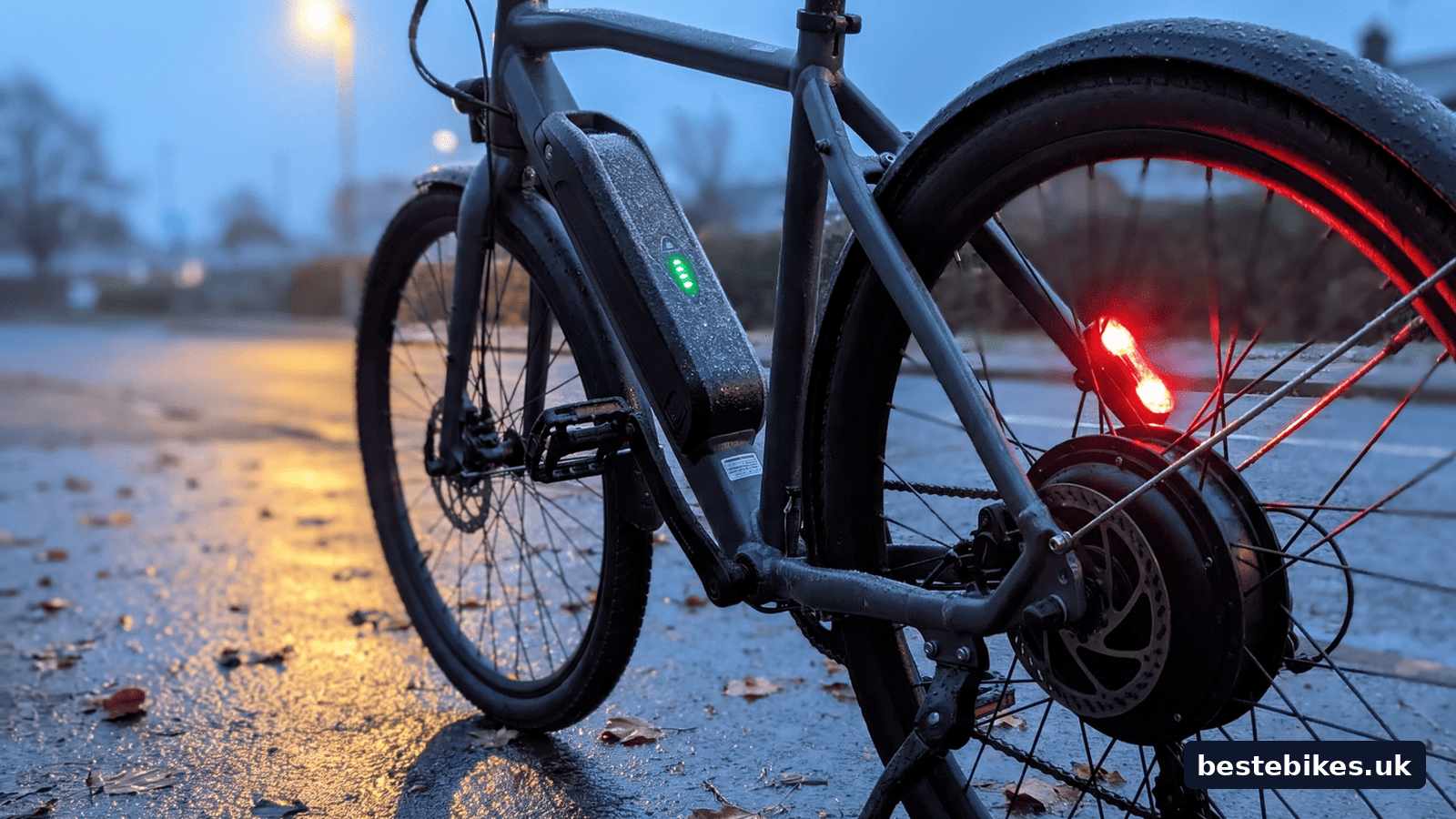
Built-in lights powered from the main battery are the easy win in winter, because they never need a separate charge and are always on the bike. Some models go further. According to their manufacturers, the Engwe L20 3.0 Pro, Engwe EP-2 3.0 Boost and Himiway A7 Pro combine automatic lights with a brake light, so the rear lamp brightens as you slow down and drivers behind get a clear signal.
| eBike | Battery (Wh) | Automatic lights | Brake light | Hydraulic brakes | Fat tyres |
|---|---|---|---|---|---|
| Engwe L20 3.0 Pro | 720 | Yes | Yes | Yes | No |
| Engwe EP-2 3.0 Boost | 648 | Yes | Yes | Yes | Yes |
| Himiway D5 2.0 | 720 | Yes | Yes | Yes | Yes |
| Engwe LE20 | 922 | Yes | Yes | Yes | No |
| Fiido M1 Pro | 557 | Yes | No | Yes | Yes |
| Fiido T2 | 998 | No | Yes | Yes | Yes |
Are hydraulic disc brakes better in the wet?
Yes. Disc brakes keep the braking surface away from the road spray that soaks a wheel rim, and hydraulic systems need a lighter pull at the lever than cable discs, which helps with cold fingers and winter gloves. On a heavier eBike carrying shopping or a child seat, that steady, predictable bite is worth having from October to March.
Wet leaves and greasy junctions still need care whatever brakes you have. Brake earlier, brake in a straight line where you can, and drop an assist level on slippery descents so the motor is not pushing you into the corner.
Do fat tyres help on winter roads?
Wider tyres put more rubber on the ground and can run at lower pressures, which gives a more forgiving ride over potholes, gravel and broken edges of the road. That makes them a comfortable choice for rural lanes and towpaths in winter. On ice, no tyre without studs offers real grip, so the honest answer on frosty mornings is to take it slowly or take the bus. Our comparison of fat tyres and road tyres covers the trade-offs in more detail.
How should I look after an eBike through winter?
Road salt is the thing to watch. After a ride on gritted roads, rinse the bike with a gentle spray of water (never a pressure washer near the motor, battery contacts or display), dry it, and re-lube the chain. Check that the battery terminals are clean and dry before you slot the pack back in. Mudguards, if your bike does not already have them, keep both you and the drivetrain far cleaner. Our eBike maintenance guide has a fuller routine.
If the bike is going into storage until spring, leave the battery part-charged rather than full or empty, keep it indoors, and top it up every few weeks. Most manufacturers give a recommended storage charge in the manual.
Ready to pick a bike that suits the darker months? Compare every eBike on Best eBikes UK and filter by lights, brakes and tyre type.
Frequently asked questions
Can I ride an eBike in the rain?
Most eBikes are built to be ridden in rain, and many manufacturers publish a water-resistance rating for the motor, battery or display. That rating covers rain and road spray, not submersion, so avoid riding through deep floodwater and never point a pressure washer at the electrics. After a wet ride, wipe the bike down, let it dry somewhere sheltered, and check the battery contacts are dry before charging. Each manufacturer's manual sets out exactly what its own rating covers.
Is it safe to charge an eBike battery in a cold garage?
It is better not to. Battery manufacturers commonly advise against charging lithium-ion cells below freezing, and many eBike manuals specify a warmer minimum still. The simplest habit is to bring the battery indoors after a ride, let it reach room temperature, and charge it there. That also means you charge where a smoke alarm can hear it, and you can unplug it once it is full rather than leaving it on charge overnight in an empty outbuilding.
Does cold weather damage an eBike battery permanently?
Riding in the cold reduces the range you get on that ride, but the battery recovers its normal performance once it warms up. Repeated charging while the cells are frozen is what manufacturers warn against, because it is the cold-weather habit most likely to cause lasting harm. Storing the battery indoors through winter, at a part charge, protects it best. Check your bike's manual for the storage charge level and temperature range its manufacturer recommends.
What lights does the law require on an eBike at night?
Between sunset and sunrise on UK roads, a bicycle, including an electrically assisted pedal cycle, must have a white front light, a red rear light, a red rear reflector and amber pedal reflectors. The Highway Code sets out these rules for cyclists and recommends reflective or light-coloured clothing after dark. Many eBikes come with front and rear lights wired to the main battery, which means the lights are always on the bike and never run flat on their own.
Should I lower the tyre pressure for winter riding?
A slightly lower pressure, kept within the range printed on the tyre sidewall, gives a larger contact patch and a more comfortable ride on rough or wet surfaces. Never go below the minimum on the sidewall, because an under-inflated tyre is more likely to pinch-puncture and makes the motor work harder, which costs range. Check pressures weekly in winter, since cold air in the tyre reads lower than it did on a warm afternoon.
How do I store an eBike over winter if I am not riding it?
Keep the bike somewhere dry and secure, remove the battery and store it indoors at room temperature. Leave the battery part-charged rather than full or flat, and top it up every few weeks so it never sits empty for long. Clean the bike and lube the chain before it goes away, so salt and grime are not left to sit on it until spring. When you bring it back out, check the tyres and brakes before the first ride.