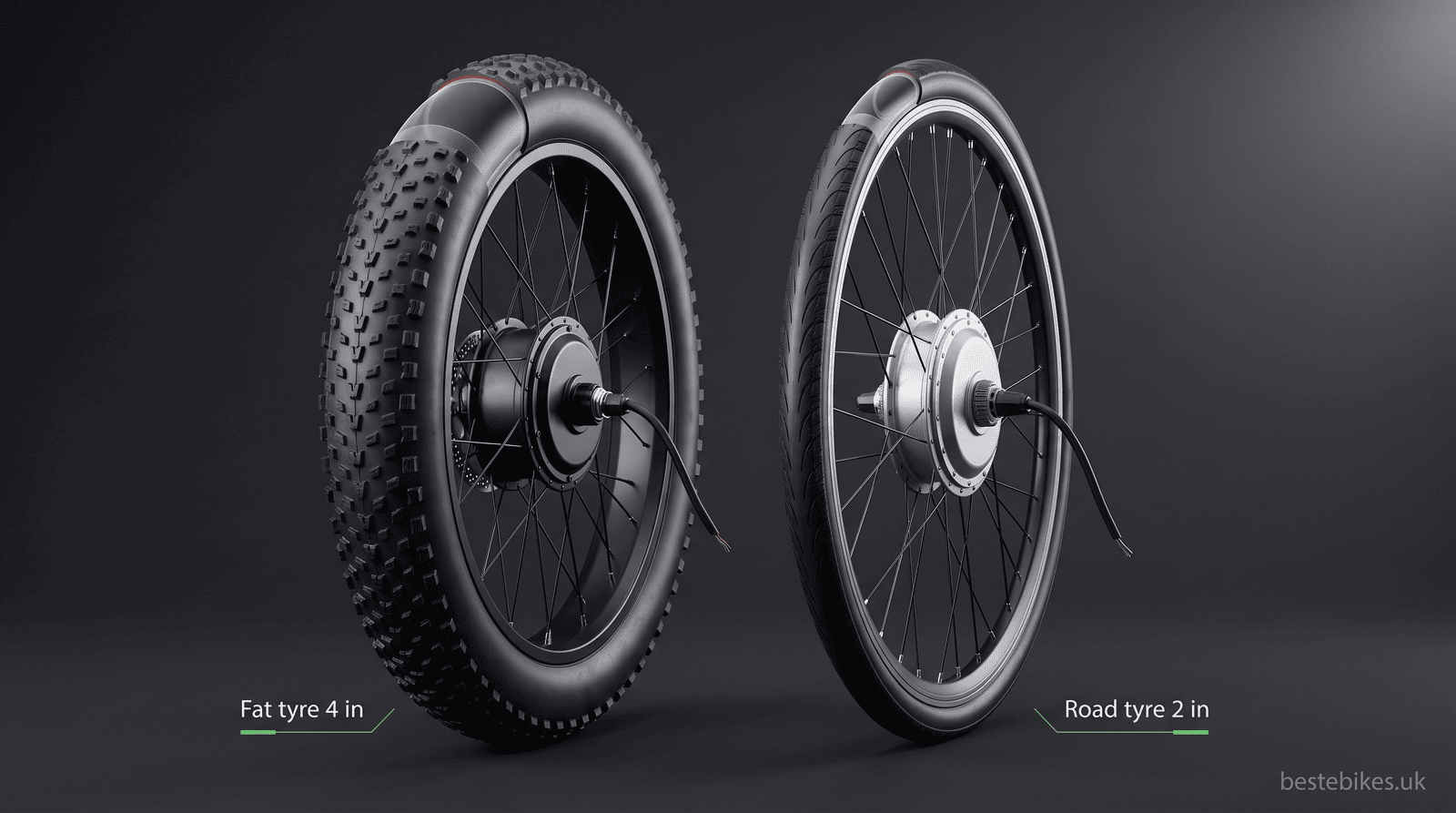
Fat tyres vs road tyres on an eBike: which should you choose?
A fat-tyre eBike gives you grip, comfort and stability on rough ground, gravel, sand and wet British lanes. A road-tyre eBike gives you a lighter bike, easier pedalling and more miles from the same battery on tarmac. Choose fat tyres for mixed surfaces and comfort, and road tyres if most of your riding is on paved roads and cycle paths.
Tyre width is the single spec that changes how an eBike feels more than any other, and it is also the one most buyers skip past on the way to the motor and battery figures. This guide compares the two approaches using the manufacturers' published specifications for the eBikes listed on Best eBikes UK. We compare specs; we do not test-ride or own the bikes.
What counts as a fat tyre on an eBike?
A fat tyre is generally anything 3 inches wide or more, and the common eBike sizes are 20 x 4.0 and 26 x 4.0 inches. The Engwe EP-2 3.0 Boost and the Fiido M1 Pro both list 20 x 4.0 tyres, while the Himiway D5 and Cyrusher Roam run 26 x 4.0. A road or urban tyre on an eBike sits between about 1.75 and 2.125 inches. The ADO Air 28 Pro lists 28 x 1.8 tyres, and the Engwe O20 Boost lists 20 x 2.125.
There is a middle ground. A 3-inch tyre such as the one on the Engwe L20 3.0 Pro is often called "plus" or "semi-fat", and it borrows a bit from each side.
How do fat tyres and road tyres compare?
| Spec or trait | Fat tyre (3 to 4 in) | Road or urban tyre (1.75 to 2.125 in) |
|---|---|---|
| Typical air pressure | Low, often under 20 psi | High, often 50 psi or more |
| Grip on gravel, sand and mud | Very good | Limited |
| Comfort over potholes and kerbs | The tyre itself absorbs a lot | Relies on suspension and the saddle |
| Rolling resistance on tarmac | Higher | Lower |
| Effect on range | Uses more battery per mile | Uses less battery per mile |
| Bike weight | Usually heavier overall | Usually lighter overall |
| Riding without assist | Hard work | Feels like a normal bike |
| Wet tarmac | Good, thanks to the large contact patch | Good with a decent tread |
Every entry in that table is a general property of tyre width, and the exact numbers depend on the tyre model, the tread and the pressure you run. Manufacturers do not usually publish rolling resistance or range-by-tyre figures, so treat the range and weight rows as direction of travel rather than a measured gap.
Why do fat tyres feel so comfortable?
Air volume. A 4-inch tyre holds several times more air than a 2-inch one, so it can run at a much lower pressure without the rim hitting the road. That low pressure lets the tyre wrap around a pothole edge or a cobble rather than bouncing off it. On a bike with no suspension at all, the tyres do the whole job, which is why so many budget fat-tyre eBikes still feel plush.
The cost of that comfort shows up on smooth tarmac. A soft, wide tyre flexes more with every rotation, and flexing rubber wastes energy. On an eBike that energy comes out of the battery, so a fat-tyre bike will typically go fewer miles on a charge than a road-tyre bike with the same battery and rider. Our range guide explains why claimed figures rarely survive contact with a British headwind, and tyre width is one of the reasons.
How much heavier is a fat-tyre eBike?
The tyres themselves are heavier, but the bigger factor is the bike built around them. Fat-tyre frames tend to be steel or heavier aluminium, with wider forks, bigger hubs and larger batteries to offset the range hit. Looking at manufacturer-quoted weights on the site, the pattern is clear.
| eBike | Tyre size | Manufacturer-quoted weight | Battery |
|---|---|---|---|
| ADO Air 28 Pro | 28 x 1.8 | 18.5 kg | 360 Wh |
| Engwe O20 Boost | 20 x 2.125 | 25 kg | 720 Wh |
| Fiido M1 Pro | 20 x 4.0 | 26.8 kg | 557 Wh |
| Engwe EP-2 3.0 Boost | 20 x 4.0 | 32.3 kg | 648 Wh |
| Cyrusher Roam | 26 x 4.0 | 37 kg | 811 Wh |
| Himiway D5 | 26 x 4.0 | 35.8 kg | 960 Wh |
Weight matters most when the motor is off. Carrying a 37 kg bike up a flight of stairs to a flat, or lifting it into a car boot, is a different proposition from an 18.5 kg one. If you live above ground level, our portable eBikes guide is worth a look before you fall for a fat-tyre look.
Which tyre is better for a UK commute?
For a commute that is mostly tarmac, cycle paths and the odd canal towpath, a road or urban tyre of around 2 inches is the sensible pick. You get more range per charge, the bike is easier to carry and store, and a 2-inch tyre with a puncture-resistant layer handles wet roads and painted lines well. The Fiido C11 Pro on 700C wheels and the Engwe P275 SE on 27.5 x 1.95 are examples of this shape of bike.
Fat tyres earn their keep when the commute includes unpaved sections, a rutted bridleway, a beach path or a winter of gritted roads. They also suit riders who want to sit upright on a padded saddle and feel very little of the road. Plenty of people buy a fat-tyre eBike for pure comfort on tarmac and are happy with the trade, as long as they know range will be shorter.
Do fat tyres need suspension too?
Not strictly, but most fat-tyre eBikes on the market include at least a front fork, and many list dual suspension. The Cyrusher Kommoda Pro and the Himiway Escape Pro both quote front and rear suspension alongside 20 x 4.0 tyres. On a bike like that the tyre handles the small, sharp stuff and the suspension deals with bigger hits.
On a road-tyre eBike, suspension does more of the work because the tyre has less give. A front fork on a 2-inch tyre bike is a real comfort upgrade, whereas on a 4-inch tyre bike it is more of a nice-to-have unless you are riding genuinely rough ground.
What about punctures and maintenance?
Both widths puncture. A fat tyre at low pressure is less prone to pinch flats from kerbs, and many manufacturers fit puncture-resistant casings as standard; the Fiido M1 Pro and Engwe Engine Pro 2.0 both list them. The catch is that fat inner tubes and tyres cost more and are stocked by fewer local bike shops, so it pays to keep a spare tube at home. Road-width tubes are on the shelf in every bike shop in the country.
Pressure checks matter more on fat tyres than you might expect. A 4-inch tyre that has drifted from 15 psi down to 8 psi will feel sluggish and eat range, and because the tyre still looks full you will not notice by eye. A cheap pressure gauge fixes that. Our maintenance guide covers the rest of the routine.
Frequently asked questions
Are fat-tyre eBikes legal in the UK?
Tyre width has no bearing on UK eBike law. An eBike is road-legal as an electrically assisted pedal cycle if the motor is rated at no more than 250 W continuous, assistance cuts out at 15.5 mph, and the motor only helps while you pedal. A fat-tyre bike that meets those rules can be ridden anywhere a bicycle can. Check the manufacturer's UK specification page, since some brands sell higher-powered versions for other markets. Our UK eBike law guide has the full detail.
Do fat tyres reduce eBike range?
Yes, on tarmac they generally do. A wide, low-pressure tyre flexes more with every turn of the wheel, and that lost energy comes out of the battery. Manufacturers rarely publish range figures broken down by tyre, so the exact penalty is not something we can quote, but it is real and you will notice it on a long paved ride. Fat-tyre eBikes often ship with larger batteries partly to compensate, which is why several on Best eBikes UK list 800 Wh or more.
Can I fit narrower tyres to a fat-tyre eBike?
Usually not by much. Fat-tyre rims are wide, often 80 mm or more, and a rim that wide will not seat a 2-inch tyre safely. Some riders drop from a 4.0 to a 3.0-inch tyre if the rim width allows, which trims weight and rolling resistance a little. Check the rim's internal width and the tyre maker's compatible range before buying, and never go outside it. Swapping to a whole new wheelset is possible but rarely worth the cost against buying the right bike first.
Are fat tyres good in the rain?
Fat tyres put a large patch of rubber on the road, which helps on wet tarmac, and their low pressure lets the tread conform to the surface. Where they shine is on wet mud, wet leaves and soft ground, which narrow tyres cut through and slide on. On a well-drained British road a decent 2-inch tyre with a proper tread is also fine in the wet, so rain alone is not a reason to go fat. Standing water and painted lines are slippery on any tyre, so ease off for those.
What pressure should I run in fat eBike tyres?
Follow the range printed on the tyre sidewall, which is the manufacturer's own limit. Fat tyres typically sit somewhere between about 5 and 20 psi, with lower pressures for sand and soft trails and higher for tarmac. Road-width eBike tyres usually run 50 psi or above. Heavier riders and heavier cargo need the upper end of the range. Check with a gauge every week or two, because a fat tyre looks fully inflated even when it is well under pressure.
Is a fat-tyre eBike harder to pedal without the motor?
Noticeably, yes. The combination of a heavy bike and wide, soft tyres means that when the battery runs flat, or you are riding above the 15.5 mph assist cut-off, you feel every kilogram. A lighter road-tyre eBike like the ADO Air 28 Pro at a quoted 18.5 kg pedals more or less like a normal bike with the motor off. If you plan to ride beyond the battery, or you like to pedal hard on the flat, that difference will matter to you every single ride.
Which fat-tyre eBikes are worth looking at in the UK?
It depends on budget and wheel size. Among 20-inch folders, the Fiido M1 Pro and Engwe EP-2 3.0 Boost both list dual suspension and 4-inch tyres at around the £1,000 mark. For a full-size 26-inch bike, the Cyrusher Roam and Himiway D5 quote larger batteries and higher torque figures. Compare their published specs side by side on Best eBikes UK, and give the manufacturer-quoted weight as much attention as the motor figure.